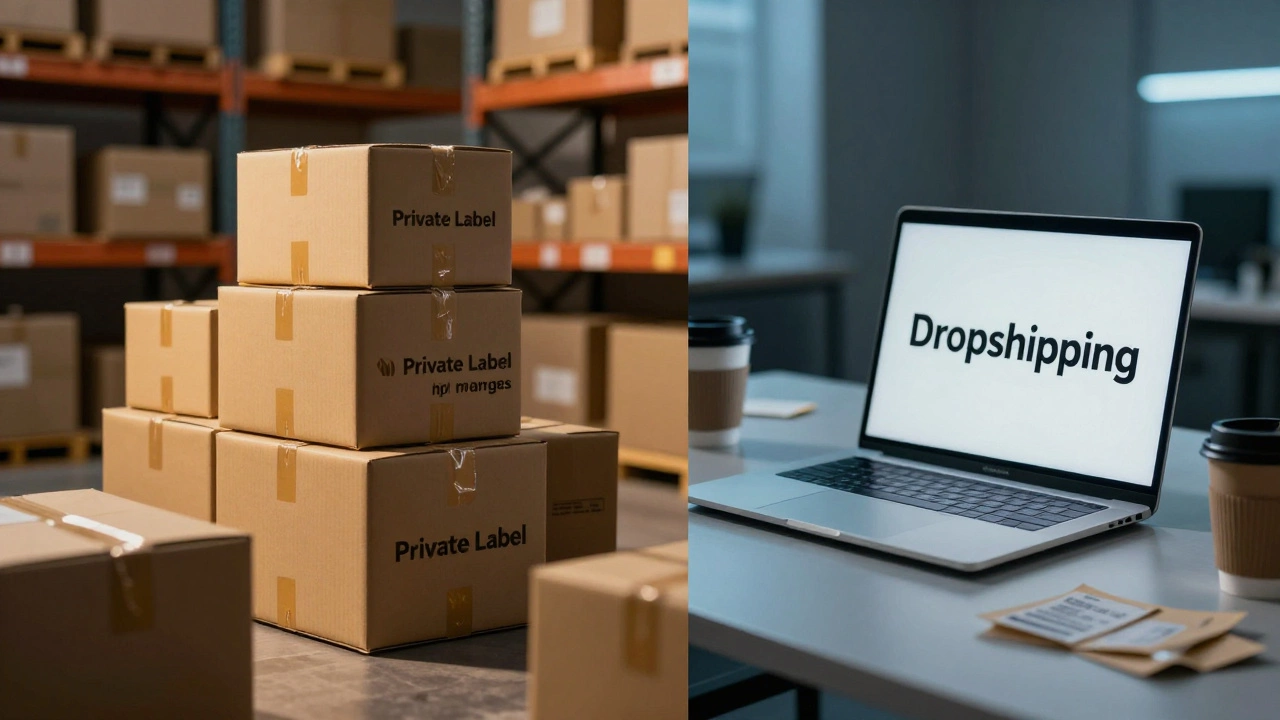
E-commerce Profitability Calculator
Enter your estimated metrics to see which e-commerce model aligns with your financial goals and risk tolerance.
You’ve probably heard the phrase "e-commerce is booming" so many times that it has lost all meaning. But here is the hard truth: while the industry grows, most new stores are bleeding money. The question isn't just about selling online; it is about which specific e-commerce model actually puts cash in your pocket after you pay for ads, shipping, returns, and platform fees.
There is no single "best" model. If there were, everyone would use it, and the profits would vanish due to competition. Instead, profitability depends on your capital, risk tolerance, and operational skills. Some models offer high margins but require heavy upfront investment. Others have low barriers to entry but razor-thin profits. Let’s break down the major players to see where the real money lies.
The High-Margin King: Private Label
If you want control over your destiny, this is the path. You work directly with manufacturers (often in China, India, or Vietnam) to create a product under your brand name. Think of brands like Anker or Gymshark. They didn’t invent the power bank or the hoodie; they branded them better than anyone else.
Why it’s profitable:
- Pricing Power: Since you own the brand, you aren’t competing solely on price against identical listings. You can charge a premium for perceived value.
- High Margins: Typical gross margins range from 40% to 60%. If you buy a unit for $5 and sell it for $30, you have plenty of room for ad spend and profit.
- Asset Value: You build an actual brand asset that can be sold later for a multiple of its earnings.
The Catch: You need upfront capital. You must buy inventory before you make a sale. If your product flops, you are stuck with boxes of unsold goods. You also handle customer service, returns, and marketing entirely on your own. It is high risk, high reward.
The Low-Risk Entry: Dropshipping
Dropshipping is a fulfillment method where you don’t keep products in stock. Instead, when a customer buys from you, you purchase the item from a third party (usually a wholesaler or manufacturer) who ships it directly to the customer.
This model exploded in popularity because you can start with almost zero money. No inventory, no warehouse, no packing tape. You focus purely on marketing and sales.
Why it seems attractive:
- Low Barrier: You can launch a store in a weekend.
- Product Testing: You can test dozens of products without financial risk. If one doesn’t sell, you delete the listing and try another.
Why it struggles with profitability: Margins are incredibly thin. Because anyone can sell the same product, competition drives prices down. Your gross margin might only be 10-20%. After paying for Facebook or Google ads, payment processing fees, and Shopify subscriptions, you might break even or lose money on every order. Additionally, you have zero control over shipping times or packaging quality. One late shipment or broken item can destroy your reputation instantly. It is a volume game, not a margin game.
The Volume Game: Retail Arbitrage & Wholesale
Retail arbitrage involves buying discounted products from retail stores (like Walmart or Target) and reselling them at full price on platforms like Amazon. Wholesale is similar but involves buying large quantities directly from brands or distributors.
Profitability Profile: This is often the fastest way to generate cash flow if you already have some capital. Margins are usually lower than private label (around 20-30%) but more stable than dropshipping. However, scalability is limited. You are dependent on finding deals or securing supply from brands. On marketplaces like Amazon, you also face strict policies and rising referral fees, which can eat into your profits unexpectedly.
The Subscription Model: Recurring Revenue
Subscription Commerce is a model where customers pay a recurring fee to receive products regularly. This applies to consumables like coffee, skincare, pet food, or software services.
Why it’s highly profitable long-term:
- Predictable Cash Flow: You know exactly how much revenue will come in next month.
- Higher Lifetime Value (LTV): Acquiring a customer is expensive. With subscriptions, you amortize that cost over months or years.
- Lower Marketing Costs: You don’t need to constantly run ads to get new sales; existing customers keep buying automatically.
The Challenge: Churn. If customers cancel their subscriptions, your growth stalls. You need exceptional product quality and customer experience to keep people subscribed. Also, managing inventory for regular shipments requires precise forecasting.
Comparison of E-commerce Models
| Model | Upfront Capital | Gross Margin | Scalability | Control Over Brand | Risk Level |
|---|---|---|---|---|---|
| Private Label | High | 40-60% | High | Full Control | High |
| Dropshipping | Very Low | 10-20% | Medium | None | Low (Financial), High (Reputation) |
| Wholesale/Arbitrage | Medium | 20-30% | Low-Medium | Low | Medium |
| Subscription | Medium-High | 30-50% | High | High | Medium (Churn Risk) |
| Digital Products | Low | 80-95% | Very High | Full Control | Low |

The Hidden Gem: Digital Products
We often forget that e-commerce isn’t just physical goods. Selling digital products-e-books, courses, templates, software plugins-offers the highest possible margins. Once you create the product, the cost of replication is zero. There is no shipping, no inventory, and no returns in the traditional sense.
Profitability: Gross margins can exceed 90%. If you sell an online course for $100, your entire profit is $100 minus transaction fees. The challenge is creating valuable content and driving traffic. Competition is fierce in popular niches, but if you solve a specific problem for a targeted audience, this model is incredibly lucrative.
Key Factors That Determine Real Profitability
Looking at margins alone is misleading. To understand which model is most profitable for you, consider these hidden costs:
- Customer Acquisition Cost (CAC): How much do you spend on ads to get one sale? In dropshipping, CAC can eat up your entire margin. In subscription models, high LTV makes a higher CAC acceptable.
- Return Rates: Clothing and electronics have high return rates (20-30%). Each return costs you shipping both ways and potential restocking fees. Private label sellers must factor this into their pricing.
- Platform Fees: Selling on Amazon or eBay means paying referral fees (15-30%) plus storage fees. Building your own website (Shopify, WooCommerce) gives you higher margins but requires you to drive your own traffic.
- Taxes and Compliance: Depending on your location, you may need to collect sales tax or VAT. Complex international shipping adds customs duties and paperwork.
Which Model Should You Choose?
Your choice depends on your starting point:
- No Money, High Time: Start with dropshipping to learn marketing and customer behavior. Reinvest profits into building a private label brand.
- Some Capital, Medium Risk Tolerance: Try wholesale or retail arbitrage to generate quick cash flow while researching private label opportunities.
- Expertise in a Niche: Create digital products or a subscription box related to your expertise. Leverage your knowledge to build trust and reduce marketing costs.
- Strong Branding Skills: Go straight to private label. Invest in quality manufacturing and branding to build a long-term asset.
Remember, profitability isn’t static. Markets change, ad costs rise, and consumer preferences shift. The most successful e-commerce entrepreneurs adapt. They start with one model, master it, and then evolve into more profitable structures as they grow.
Is dropshipping still profitable in 2026?
Dropshipping is still viable, but it is no longer a "get rich quick" scheme. Success requires exceptional marketing skills, niche selection, and supplier relationships. Margins are thin, so you must focus on high-volume sales or upselling to make significant profits. Many successful dropshippers eventually transition to private label to improve margins and control.
What is the average profit margin for private label e-commerce?
A healthy gross margin for private label products is typically between 40% and 60%. However, net profit margin (after ads, operations, and taxes) usually ranges from 10% to 20%. Highly optimized brands with strong direct-to-consumer channels can achieve net margins of 25% or more.
How much money do I need to start a private label business?
Starting a private label business typically requires $2,000 to $5,000 minimum. This covers initial inventory orders, product samples, branding/design, website setup, and initial advertising budget. Costs vary significantly depending on the product type, manufacturer location, and order quantity.
Is selling digital products easier than physical products?
Digital products eliminate logistics headaches like shipping, inventory, and returns. However, they require strong expertise and content creation skills. Marketing digital products can be challenging because you're often selling intangible value. Physical products have tangible benefits but come with operational complexity.
Can I combine multiple e-commerce models?
Yes, many successful businesses hybridize models. For example, you might start with dropshipping to test products, then switch to private label for bestsellers. Or you could sell physical products alongside complementary digital guides. Combining models allows you to diversify revenue streams and mitigate risks associated with any single approach.
