
LLC vs. Self-Employed Tax Calculator
Key Threshold
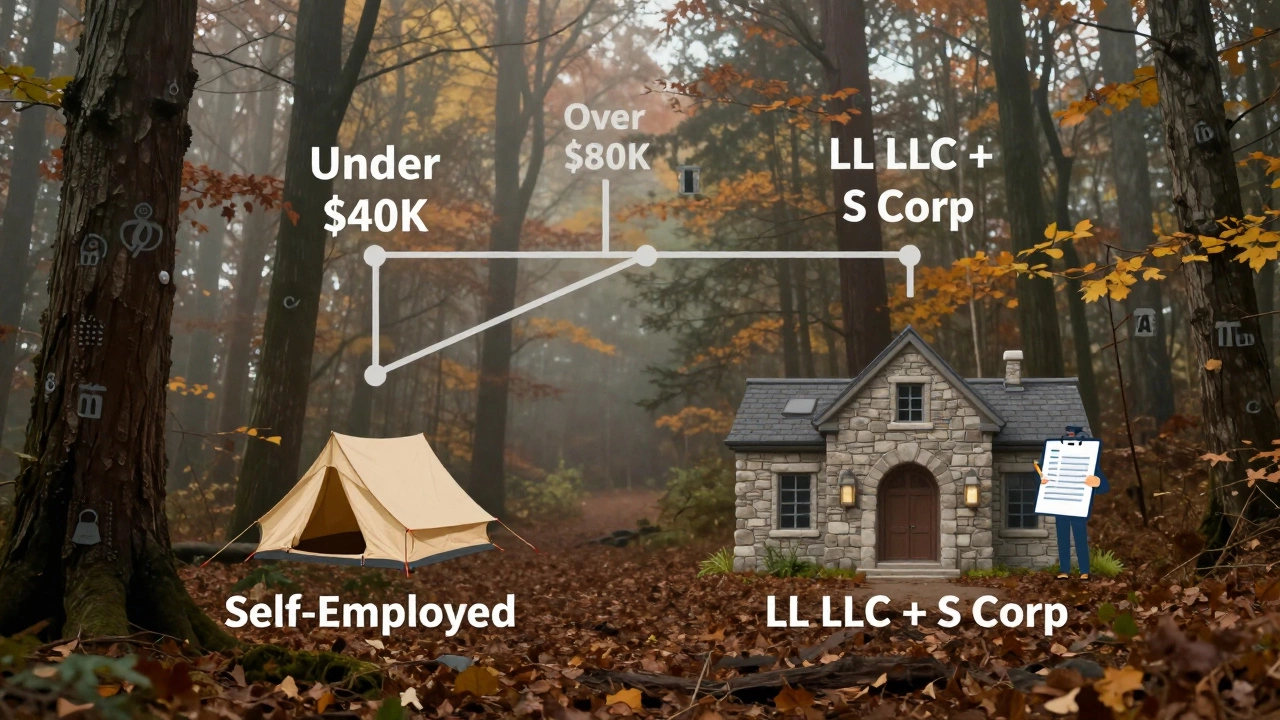
Most experts recommend forming an LLC when you earn over $80,000 net income. Below this threshold, setup costs often outweigh tax benefits.
Your Results
Enter your net income to see tax comparison
When you start earning money on your own, one of the first real questions you’ll face isn’t about clients or branding-it’s about taxes. Should you file as a sole proprietor (self-employed) or form an LLC? It sounds simple, but the answer changes how much you pay, what paperwork you handle, and even how protected you are if things go sideways.
Let’s cut through the noise. There’s no universal "better" option. What works for a freelance graphic designer in Austin might be a disaster for a consulting firm in Chicago. The right choice depends on your income, your risk level, and your long-term goals-not what some blog says is "the smartest move."
What does it mean to file as self-employed?
If you’re operating as a sole proprietor, you’re legally the same as your business. That means all income flows directly to you, and you report it on Schedule C of your personal tax return (Form 1040). No separate business tax return. No corporate filings. Just you, your earnings, and your expenses.
Here’s the catch: you pay self-employment tax. That’s 15.3%-12.4% for Social Security and 2.9% for Medicare-on your net profit. There’s no cap on the Medicare portion, and you pay it even if you’re already contributing through a day job. If you made $60,000 net, that’s $9,180 in self-employment tax alone.
But here’s the upside: it’s simple. You don’t need to open a business bank account, file extra forms with your state, or pay annual fees. In 2025, the IRS reported that over 32 million sole proprietors filed taxes this way. Most of them are solopreneurs making under $75,000 a year. For many, the simplicity outweighs the tax cost.
What changes when you form an LLC?
An LLC (Limited Liability Company) isn’t a tax classification-it’s a legal structure. The IRS doesn’t recognize LLCs as a tax category. Instead, it defaults to one of two things:
- Single-member LLC: Treated as a disregarded entity. You file like a sole proprietor, using Schedule C.
- Multi-member LLC: Treated as a partnership. You file Form 1065, and each member gets a K-1.
Wait-if a single-member LLC files just like a sole proprietor, then what’s the point?
The difference isn’t in taxes. It’s in protection and options.
As a sole proprietor, your personal assets-your house, your car, your savings-are on the line if someone sues your business. An LLC creates a legal wall. If a client sues you for a failed project, they can’t go after your personal assets. That’s huge if you’re doing work with high liability risk: construction, healthcare consulting, or even coaching clients with mental health goals.
And here’s where things get interesting: an LLC can elect to be taxed as an S Corporation. That’s not automatic. You have to file Form 2553 with the IRS. But once you do, you can pay yourself a "reasonable salary" and take the rest as distributions. Distributions aren’t subject to self-employment tax.
Let’s say you make $120,000 net. As a sole proprietor, you pay 15.3% on the full amount: $18,360. As an LLC taxed as an S Corp, you pay yourself $70,000 as salary (subject to payroll taxes) and take $50,000 as a distribution. You only pay self-employment tax on the $70,000: $10,710. That’s a savings of $7,650. That’s more than a month’s rent in most cities.
When does an LLC make financial sense?
It’s not about how much you earn-it’s about how much you can save after accounting for costs.
Forming an LLC costs money. In most states, it’s $50-$500 to file. You’ll also need an EIN, a business bank account, and possibly annual reports or franchise taxes. In California, it’s $800/year just for the franchise tax. In Texas, it’s $0 if you make under $2.4 million. So location matters.
Most tax pros agree: if you’re making under $40,000 net, the cost of an LLC usually outweighs the tax savings. At $60,000-$80,000, it starts to get interesting. Once you hit $100,000+, the S Corp election becomes a strong contender.
But here’s what most people miss: the S Corp election isn’t magic. The IRS requires you to pay yourself a "reasonable salary"-what someone else would pay for your skills in your area. If you’re a web developer in Atlanta making $120,000, you can’t pay yourself $30,000 and take $90,000 as distributions. The IRS will reclassify it, slap you with back taxes, and add penalties.
Real-world example: A freelance copywriter in Denver made $140,000 in 2024. She set her salary at $85,000 (aligned with local market rates) and took $55,000 as distributions. Her self-employment tax dropped from $21,420 to $12,950. Net savings: $8,470. Her LLC cost $350 to form and $120/year to maintain. She saved over $8,000. Easy win.

When should you stick with self-employed?
If you’re just starting out, testing a side hustle, or making less than $40,000, skip the LLC. The paperwork, fees, and complexity aren’t worth it. You’ll spend more time filing forms than you’ll save in taxes.
Also, if you don’t have the cash to cover annual fees, legal compliance, or payroll taxes, don’t force it. You can always switch later. The IRS lets you change your tax status at any time, as long as you file the right forms.
And if you’re in a low-risk business-like writing, tutoring, or selling digital products-your liability exposure is minimal. The legal protection of an LLC matters less when you’re not handling physical products or client funds.
One more thing: you can’t deduct your LLC formation costs as a business expense in the year you start. They’re capitalized and amortized over 15 years. That means if you spent $500 to form your LLC, you can only deduct $33.33 per year. That’s not a tax break-it’s a delay.
What about state taxes?
Federal rules are one thing. State rules? They’re a mess.
Some states, like Nevada and Wyoming, have no corporate income tax. Others, like New Jersey and Oregon, tax LLCs on gross receipts, not profit. In New York, LLCs pay an annual fee based on income-up to $4,500 for businesses over $1 million.
If you’re operating in multiple states, you might need to register as a foreign LLC. That adds more fees and reporting. For many remote freelancers, staying as a sole proprietor avoids this headache entirely.
Bottom line: check your state’s LLC rules before you pay $300 to form one. A quick search for "[Your State] LLC tax" will show you if it’s a benefit or a burden.
What about retirement and benefits?
Both structures let you set up retirement accounts. As a sole proprietor, you can open a SEP IRA or Solo 401(k). Same for an LLC. The contribution limits are identical. So no tax advantage there.
But here’s the real difference: if you’re an LLC taxed as an S Corp, you can pay yourself a salary and contribute to a 401(k) through payroll. That means you can make employer contributions on top of your own. Sole proprietors can’t do that. The difference is small unless you’re making over $200,000-but for some, it adds up.
What’s the real decision?
You don’t need to choose forever. Most people start as self-employed, then switch to an LLC when they hit a certain income level or risk threshold.
Ask yourself:
- Are you making more than $80,000 net per year?
- Do you work with clients who could sue you (e.g., health, finance, construction)?
- Can you afford $500-$1,000 in setup and annual fees?
- Are you comfortable hiring a CPA to handle payroll and S Corp filings?
If you answered yes to all four, consider an LLC taxed as an S Corp.
If you answered no to any of them, stay self-employed. Save your money. Grow your business. Switch when it makes sense-not because you think you "should."
And remember: the goal isn’t to pay the least in taxes. It’s to keep more of what you earn after accounting for time, stress, and cost. For most people, that’s still self-employed. For others? It’s an LLC with an S Corp election. Either way, you’re ahead if you make the choice based on facts-not hype.
Can I switch from self-employed to LLC later?
Yes, you can switch anytime. You’ll need to file Articles of Organization with your state, get an EIN, and open a business bank account. If you want to be taxed as an S Corp, you’ll also file Form 2553 with the IRS. The IRS allows you to change your tax classification once per tax year. Most people wait until their income hits $80,000-$100,000 before making the move.
Do I need a business bank account if I form an LLC?
Technically, no-but if you don’t, you risk losing your liability protection. Courts can "pierce the corporate veil" if your personal and business finances are mixed. That means your home or car could be at risk if someone sues your business. Opening a separate account is one of the easiest ways to keep your LLC protection intact.
Does an LLC protect me from all lawsuits?
No. An LLC protects you from business debts and liabilities, but not from your own wrongful acts. If you commit fraud, embezzle funds, or personally injure someone, you can still be held personally liable. Also, if you personally guarantee a loan or lease, creditors can come after your personal assets. LLCs are shields, not force fields.
Can I file as an LLC and still use my personal bank account?
You can, but you shouldn’t. Mixing personal and business funds is the #1 reason courts ignore LLC protection. Even if you’re the only owner, treat your LLC like a separate entity. Pay yourself a salary, keep receipts, and use a dedicated account. It takes five minutes to set up and saves you from legal disaster later.
Is it worth hiring a CPA for an LLC taxed as an S Corp?
Yes, especially if you’re making over $80,000. S Corp payroll requires accurate salary calculations, quarterly tax filings, and W-2s. A mistake can trigger IRS audits or back taxes. Most CPAs charge $1,500-$3,000/year for this service. If you’re saving $5,000-$10,000 in self-employment tax, that’s a no-brainer.
