Japan Export Calculator
Export Calculator
Key Data
Japan's export value is 18% automotive products ($170B)
Top importers: US (24%), China (19%), Thailand (7%), Singapore (5%), Germany (4%)
Note: Values based on 2025 trade data from Japan Customs
Export Breakdown
Top Importing Countries
When you think of Japan, you might picture bullet trains, sushi, or robots. But behind those iconic images is a powerful engine of global trade: Japan's exports. For decades, Japan has been one of the world’s top exporters, and its economy doesn’t run on tourism or services alone-it runs on what it builds and ships overseas.
What Japan Actually Ships Out
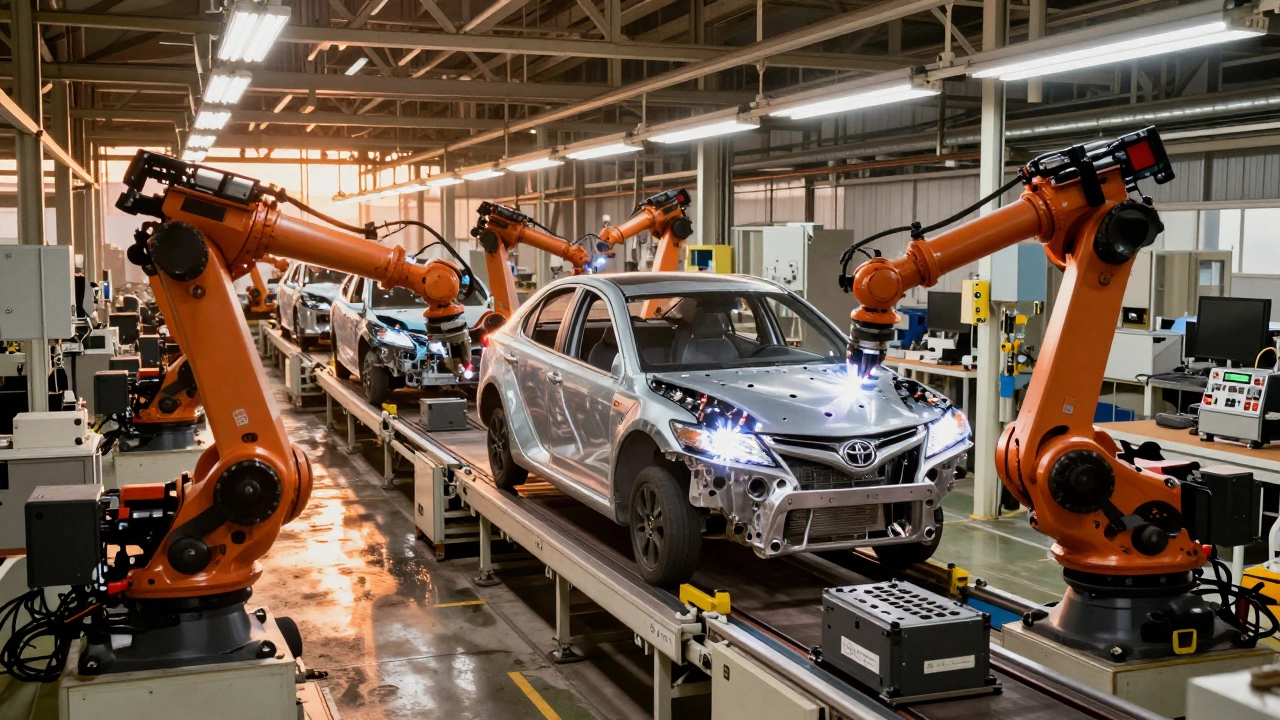
Japan doesn’t just export one thing. But if you had to pick the single biggest category, it’s motor vehicles and automotive parts. In 2025, cars, trucks, and auto components made up about 18% of Japan’s total export value, according to Japan Customs data. That’s more than $170 billion in sales to countries like the United States, China, Thailand, and Australia.Toyota, Honda, Nissan, and Subaru don’t just sell cars abroad-they ship engines, transmissions, and electronic control units that go into vehicles built in other countries. A single Toyota Camry sold in the U.S. might have parts made in five different Japanese factories, then assembled in Kentucky. That’s the hidden scale of Japan’s export machine.
Beyond Cars: The Other Big Exporters
While vehicles lead, Japan’s export list is packed with high-tech and precision-made goods. Here are the next top players:- Electronics and semiconductors - Japan produces over 30% of the world’s advanced semiconductor materials, including photoresists and high-purity silicon. Companies like Tokyo Electron and Renesas supply chips and components to Apple, Samsung, and Intel.
- Machinery and industrial equipment - From CNC machines to robotics, Japan’s factory gear is used in factories worldwide. Fanuc robots, for example, assemble smartphones in China and build cars in Germany.
- Chemicals and pharmaceuticals - Japan is a top exporter of specialty chemicals used in cosmetics, batteries, and medical devices. Its drug exports, including vaccines and cancer treatments, hit $22 billion in 2025.
- Iron and steel products - Nippon Steel and JFE Steel ship high-grade steel for construction, shipbuilding, and wind turbines across Asia and Europe.
- Optical and medical instruments - Canon, Nikon, and Olympus export lenses, endoscopes, and imaging systems used in hospitals and labs globally.
These aren’t low-margin commodities like soybeans or coal. Japan exports high-value, high-tech products that other countries can’t easily copy. That’s why its export margins stay strong even when global demand dips.
Why Japan Dominates in These Categories
It’s not luck. Japan’s export success comes from decades of focused investment:- Quality control - Japanese manufacturers follow kaizen (continuous improvement) and just-in-time production. Defect rates in car manufacturing are under 0.1%-far lower than global averages.
- Supply chain control - Japan owns or heavily influences key parts of global supply chains. For example, 90% of the world’s fluorinated gases used in chipmaking come from Japanese firms.
- Government-industry partnerships - The Ministry of Economy, Trade and Industry (METI) works directly with companies to identify export opportunities and protect intellectual property abroad.
- Engineering culture - Japanese engineers are trained to solve problems others ignore. A tiny vibration in a turbine? They’ll redesign the bearing. A camera lens that’s 0.01mm off? They’ll rebuild the mold.
This isn’t about volume-it’s about precision. A Japanese-made industrial robot might cost 30% more than a Chinese one, but it runs 50% longer with zero downtime. That’s why factories keep buying them.
Who Buys Japan’s Exports?
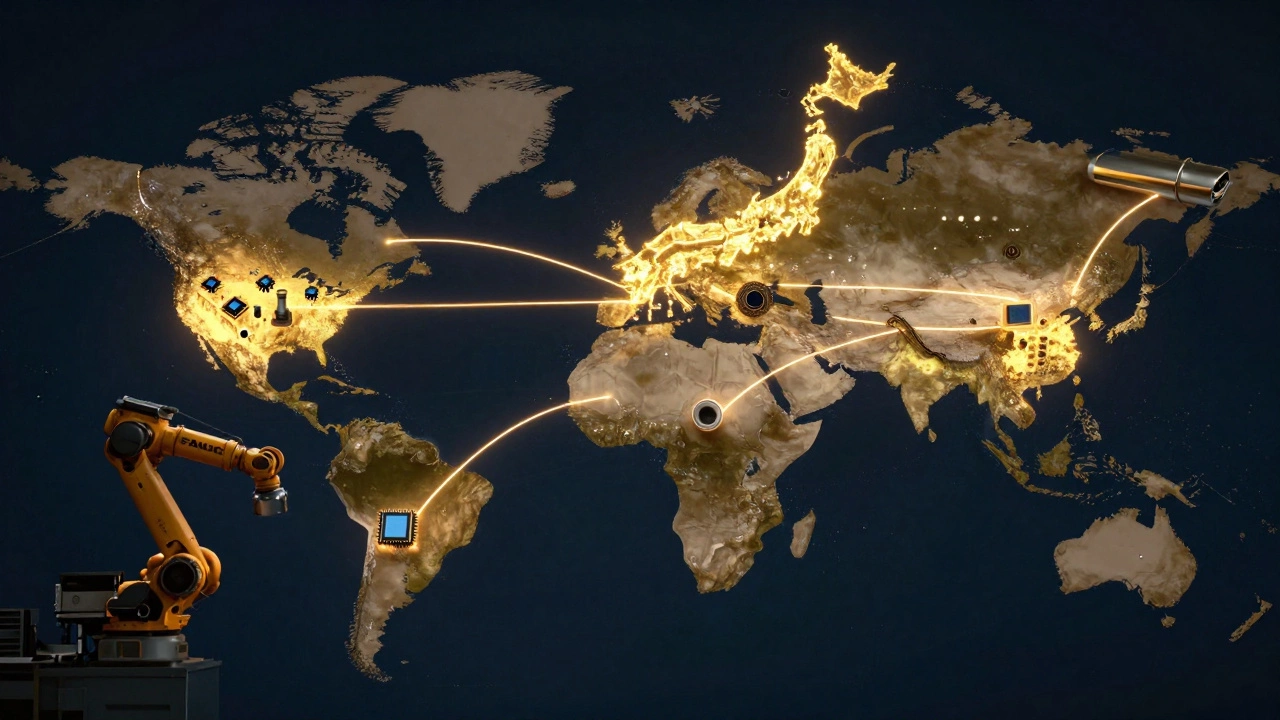
Japan doesn’t rely on one market. Its exports are spread across continents:| Country | Share of Japanese Exports | Main Imports |
|---|---|---|
| United States | 24% | Cars, electronics, medical devices |
| China | 19% | Semiconductors, machinery, auto parts |
| Thailand | 7% | Auto parts, plastics, industrial equipment |
| Singapore | 5% | Chemicals, pharmaceuticals, electronics |
| Germany | 4% | Machinery, steel, precision tools |
| South Korea | 3% | Chemicals, sensors, batteries |
The U.S. and China together take nearly half of Japan’s exports. But emerging markets like Vietnam and India are growing fast. In 2025, exports to India jumped 18% year-over-year-mostly in auto components, medical devices, and industrial robots.
What Japan Doesn’t Export Much Of
It’s just as important to know what’s missing. Japan exports very little in:- Agricultural products - Despite being a top rice producer, Japan imports over 60% of its food. High tariffs and domestic subsidies limit exports of beef, dairy, or vegetables.
- Raw materials - Japan has almost no oil, gas, or minerals. It imports everything it can’t make.
- Fast fashion or consumer goods - You won’t find Japanese T-shirts or plastic toys dominating global markets. Their strength is in components, not mass-market retail.
This tells us something important: Japan doesn’t compete on price. It competes on performance, reliability, and innovation. A Japanese diesel engine might cost twice as much as a Turkish one-but it lasts 200,000 kilometers longer. That’s the trade-off buyers accept.
How This Affects Global Trade (Especially for India)
For countries like India, Japan’s export model is a lesson. India exports a lot of software, textiles, and pharmaceuticals-but not high-end machinery or precision components. Japan’s success shows that long-term export growth comes from:- Investing in R&D, not just labor costs
- Building supply chains around core strengths
- Training engineers to solve hard problems, not just meet quotas
Japan’s auto parts exports to India are growing because Indian manufacturers need reliable, high-precision components to build their own cars. India can’t just export cheap goods-it needs to export dependable goods. Japan’s example proves that’s possible.
The Future of Japan’s Exports
Japan isn’t resting. In 2025, it launched its Next-Gen Export Strategy, focusing on:- Exporting hydrogen fuel cell tech to Europe and Southeast Asia
- Shipping AI-powered factory automation systems to emerging economies
- Expanding medical device exports to Africa and Latin America
Japan’s exports are no longer just about cars and electronics. They’re about the systems that make modern industry possible. From the battery in your electric car to the sensor in your hospital ventilator-chances are, a Japanese company made the core part.
If you’re in export business, whether in India or anywhere else, Japan’s story isn’t just about trade numbers. It’s about building something others can’t easily replace-and then making sure the world needs it.
What is Japan's biggest export product?
Japan’s biggest export product category is motor vehicles and automotive parts. In 2025, this sector accounted for about 18% of total export value, totaling over $170 billion. Cars like the Toyota Camry, Honda Accord, and Nissan Altima are shipped globally, along with critical components like engines, transmissions, and electronic control units.
Does Japan export food or agricultural products?
Japan exports very little agricultural product compared to its industrial goods. While it produces high-quality rice, beef, and seafood, domestic demand and strict import protections limit exports. Only about 5% of Japan’s total exports come from agriculture, and even then, it’s mostly premium items like Wagyu beef or matcha tea to niche markets like the U.S. and Hong Kong.
Why does Japan export so many semiconductors?
Japan doesn’t make the final chips like Apple or NVIDIA, but it controls the materials and equipment needed to make them. Japanese firms produce over 90% of the world’s photoresists, 70% of the fluorinated gases, and 60% of the silicon wafers used in chip manufacturing. Without these inputs, global semiconductor production would stall-making Japan a hidden backbone of the tech industry.
Which countries import the most from Japan?
The top importers of Japanese goods in 2025 were the United States (24%), China (19%), Thailand (7%), Singapore (5%), and Germany (4%). The U.S. mainly buys cars and medical devices, China imports semiconductors and machinery, and Southeast Asian nations rely on auto parts and industrial equipment.
Can India compete with Japan’s export model?
India can’t copy Japan overnight, but it can learn from it. Japan succeeded by focusing on high-value, precision manufacturing-not low-cost labor. India has strong IT and pharmaceutical exports, but to match Japan’s impact, it needs to invest in advanced engineering, supply chain control, and quality standards. Exporting reliable industrial robots or high-grade steel components could be India’s next step.
