
LLC Tax Filing Calculator
Calculate Your Filing Requirement
Results
Enter your details above to see if you need to file a tax return.
Many new business owners wonder: if my LLC made zero dollars this year, do I still have to file a tax return? The answer isn’t as simple as "no." Even if your LLC didn’t earn a single dollar, you might still be required to file - and skipping it could cost you more than you think.
LLCs Are Not One-Size-Fits-All
First, you need to understand how your LLC is taxed. The IRS doesn’t recognize LLCs as a separate tax entity. Instead, it looks at how you elected to be taxed: as a sole proprietorship, partnership, or corporation. This decision changes everything.
- If you’re a single-member LLC and didn’t make any changes, you’re taxed as a sole proprietor. That means your business income flows through to your personal tax return (Form 1040 with Schedule C).
- If you have multiple members, you’re taxed as a partnership by default. That means you must file Form 1065, even if there was no profit.
- If you filed Form 8832 to be taxed as a corporation (C-corp or S-corp), then you must file a corporate tax return - no matter what.
So, if you’re a single-member LLC with no income, you don’t need to file a separate business return. But you still need to report your business activity on your personal return - even if it’s zero.
Why You Still Might Need to File
Here’s the catch: the IRS doesn’t just care about income. They care about activity. If your LLC had any expenses - even $50 in bank fees, $120 for a website domain, or $300 for accounting software - then you have to report it. Why? Because those expenses can offset future income. If you don’t file, you lose the ability to carry forward those losses.
Also, if your LLC had employees, even temporarily, you must file payroll tax returns. That includes withholding taxes, Social Security, and Medicare. No income? Still need to file.
And if you paid yourself through draws or distributions - even if it wasn’t salary - you still need to track it. The IRS tracks LLCs by their EIN. If your LLC has one (and most do), then you’re on their radar. Ignoring it doesn’t make it disappear.
What Happens If You Don’t File?
You might think, "I didn’t make money, so they won’t care." That’s a dangerous assumption.
The IRS doesn’t send a bill if there’s no tax owed. But they do send notices. And those notices can trigger audits, especially if your LLC has been inactive for more than a year. You could get flagged for "inconsistent reporting" if last year you filed with $12,000 in income and this year you filed nothing - with no explanation.
Some states are even stricter. In California, for example, all LLCs must file Form 568 and pay the $800 annual franchise tax - even if they made $0. Miss that payment, and penalties start piling up fast. In New York, you could lose your LLC status if you don’t file annual reports.
And if you ever want to open a business bank account, apply for a loan, or sell your business later? You’ll need a clean tax history. Lenders and buyers want to see consistent filings - even for zero-income years.
What to Do If You Made Zero Income
Here’s how to handle it cleanly:
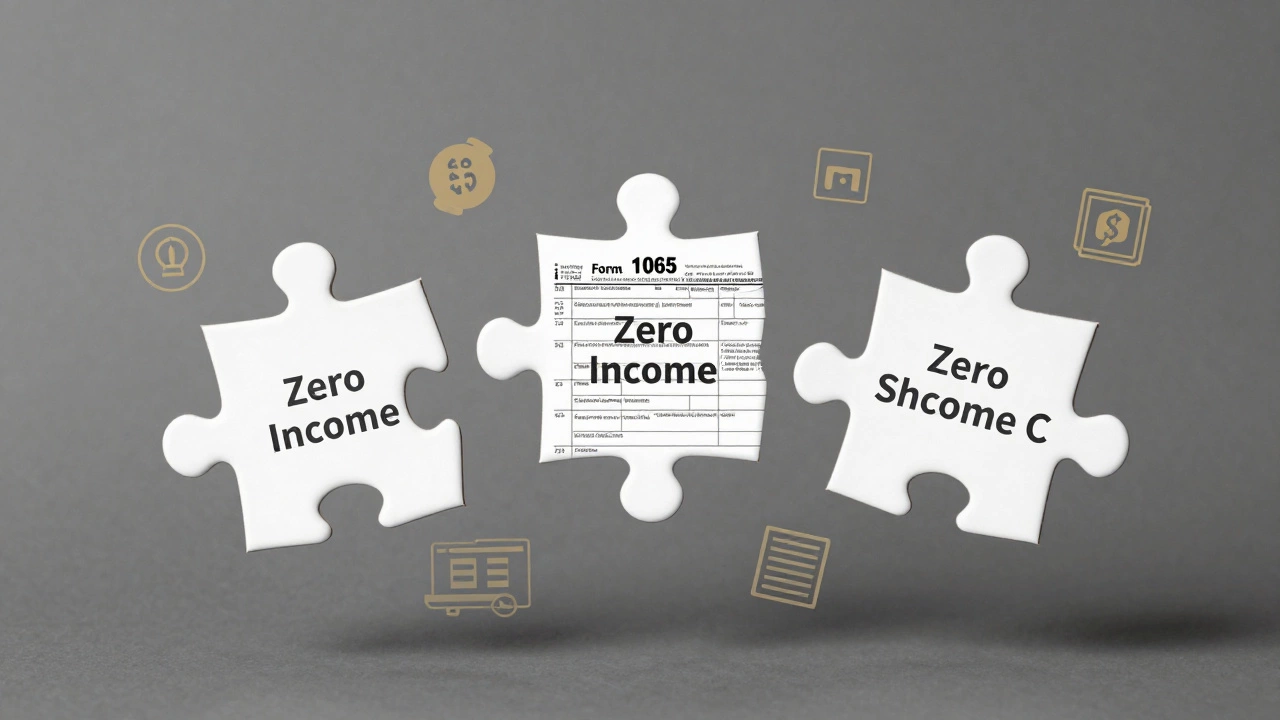
- Single-member LLC: File your personal tax return (Form 1040) and include Schedule C. Enter zeros for income and expenses. Keep receipts for all business spending - even small ones - in case the IRS asks.
- Multi-member LLC: File Form 1065. Report $0 in revenue and list all expenses. Each member gets a Schedule K-1 showing their share of losses. Keep copies for your records.
- LLC taxed as a corporation: File Form 1120 (C-corp) or Form 1120-S (S-corp). Even if you had no sales, you still need to report expenses and losses.
Don’t skip filing just because it’s "easy" to ignore. The time you save now could cost you hundreds - or thousands - later.
Common Mistakes People Make
Here are the top three errors I see:
- Thinking "no income = no filing": You’re not just reporting income. You’re reporting activity. Expenses matter.
- Forgetting state rules: Federal rules are one thing. State rules are another. Some states require annual reports, franchise taxes, or informational filings regardless of income.
- Not keeping records: If you didn’t file, and then the IRS asks for proof of expenses two years later - you’re out of luck. Save every receipt, invoice, and bank statement.
When You Can Skip Filing
There’s one scenario where you truly don’t need to file: if you never formally created the LLC, never got an EIN, never opened a business bank account, and never spent a dime on business expenses.
But if you did any of those things - even once - then you’re in the system. And the system expects you to file.
Think of it like this: your LLC is like a car. Even if you never drove it, you still need to register it and pay the annual fee. Same idea.
Pro Tip: Use the Same Date Every Year
Set a reminder to file your LLC tax return on the same date each year - even if it’s just a form with zeros. Consistency builds trust with the IRS. It also makes it easier to spot problems later. If next year you suddenly have $50,000 in income, you’ll know your records are clean and ready.
Final Thought
There’s no such thing as a "free" year in business. Even when you’re not making money, you’re still building a record. That record matters. Filing with $0 income isn’t a waste of time - it’s insurance. It protects your business, your credit, and your future.
Do I need to file a tax return for my LLC if I made no money?
Yes - depending on how your LLC is taxed. Single-member LLCs must report activity on Schedule C with your personal return. Multi-member LLCs must file Form 1065. LLCs taxed as corporations must file Form 1120 or 1120-S. Even with $0 income, expenses and activity require filing.
What if I didn’t spend any money either?
If your LLC never opened a bank account, never got an EIN, never paid for anything, and never operated - then technically you don’t need to file. But if you did any of those things, even once, you’re required to file. The IRS tracks LLCs by EIN and state registration, not by income.
Can I skip filing to save time and money?
It might seem like the easiest option, but skipping filing risks penalties, audits, or losing your LLC status. Some states charge $800/year just to keep your LLC active. If you miss a filing, you could owe back fees, interest, and lose your legal protection. The short-term savings aren’t worth the long-term risk.
Do I need to file if my LLC is inactive?
Yes. An inactive LLC is still a legal entity. Most states require annual reports and fees. The IRS still expects tax filings if you have an EIN or have ever reported business activity. Inactivity doesn’t mean exemption.
Will the IRS notice if I don’t file?
They might not immediately, but they will eventually. If your LLC has an EIN, the IRS has a record of it. If you filed last year and skip this year, it raises a red flag. States also cross-check LLC filings with tax records. Missing filings can lead to penalties, loss of status, or even forced dissolution.
