
AI-Ready Marketer Score Calculator
Your AI-Readiness Score
Action Plan:
There is a loud rumor circulating in boardrooms and coffee shops alike: Will ChatGPT replace digital marketing? If you are a marketer in India or anywhere else, the anxiety is real. You see tools churning out blog posts in seconds, designing ads without human input, and managing customer chats while you sleep. It looks like the end of an era. But before you panic about your job security or rewrite your business plan, let’s look at what is actually happening under the hood.
The short answer is no. ChatGPT, developed by OpenAI, is not replacing digital marketing. Instead, it is replacing specific tasks within it. Think of it less as a replacement for the driver and more as a turbocharger for the car. The destination-connecting with customers-remains the same, but the speed and efficiency have changed drastically. In 2026, the marketers who survive are not those who fight AI, but those who learn to steer it.
The Shift from Execution to Strategy
To understand why ChatGPT won’t take over, we first need to define what digital marketing actually is today. It is not just writing emails or posting on social media. It is a complex ecosystem involving psychology, data analysis, brand positioning, and strategic planning. For years, a huge chunk of a marketer’s time was spent on execution-drafting copy, resizing images, answering basic FAQs. This is where Generative AI shines.
In the Indian market, where cost-efficiency and scale are paramount, this shift is even more pronounced. A small startup in Bangalore can now produce content that rivals a large agency in Mumbai using AI tools. However, producing content is not the same as creating a brand. Brand building requires understanding cultural nuances, local sentiments, and emotional triggers. An AI can write a perfect Hindi slogan, but it cannot understand the subtle irony in a regional meme or the emotional weight of a festival season campaign without significant human guidance.
The role of the digital marketer is shifting from 'doer' to 'editor-in-chief'. You are no longer paid to type fast; you are paid to think critically. Your value lies in deciding what to say, to whom, and why. The AI handles the 'how'. This means jobs focused purely on repetitive tasks-like basic SEO keyword stuffing or generic email blasts-are indeed disappearing. But roles requiring strategic oversight, creative direction, and data interpretation are growing.
What AI Can Actually Do Right Now
Let’s be realistic about the capabilities of Large Language Models (LLMs) like ChatGPT, Claude, and Gemini. They are incredibly powerful at pattern recognition and synthesis. Here is what they handle exceptionally well:
- Content Drafting: Generating first drafts for blogs, social media captions, and ad copies. This reduces writer’s block and speeds up production cycles by up to 70%.
- Data Analysis: Processing large datasets to find trends. Instead of staring at Excel sheets for hours, you can ask an AI to summarize customer behavior patterns from your CRM data.
- Personalization at Scale: Creating unique variations of messages for different customer segments. This is crucial for email marketing and retargeting campaigns.
- Customer Support: Handling initial queries via chatbots, freeing up human agents to deal with complex issues.
For example, an e-commerce brand selling ethnic wear in Jaipur can use AI to generate product descriptions in multiple languages instantly. This helps them reach a broader audience across India without hiring a team of translators. But notice what the AI did not do: it did not decide which products to feature, nor did it understand the cultural significance of certain designs during specific festivals. That required human insight.
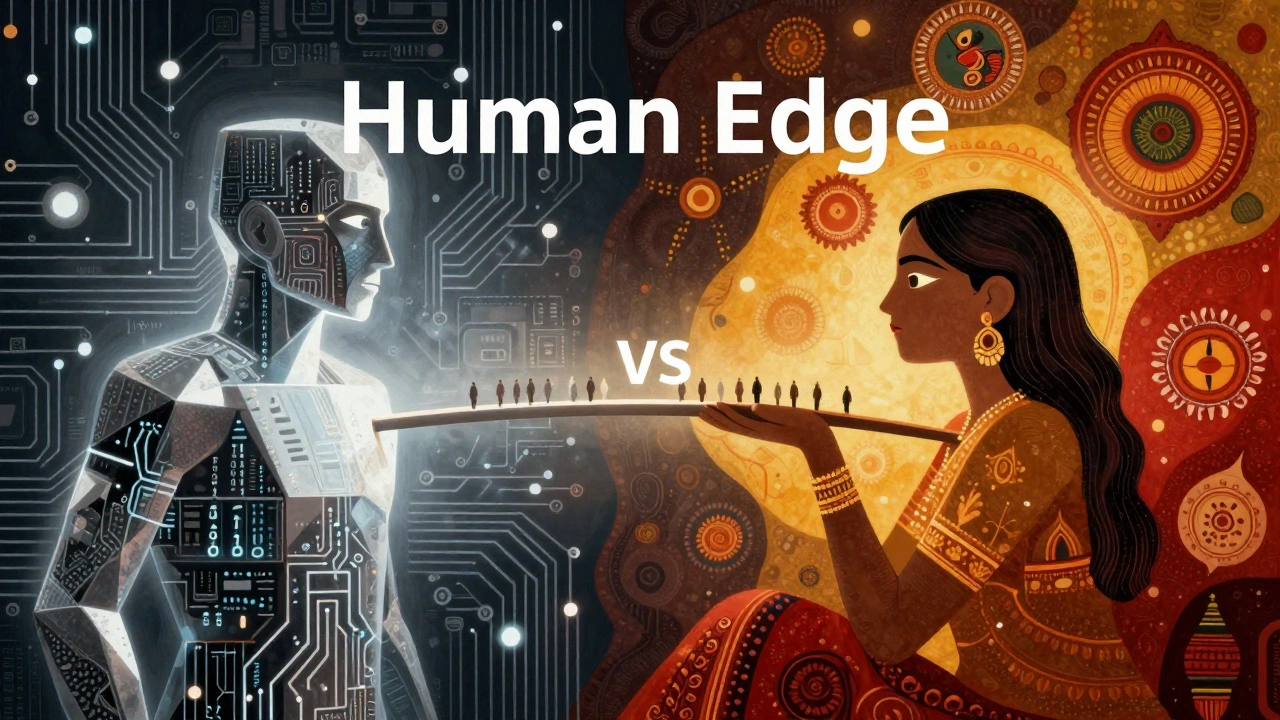
The Human Edge: Empathy and Creativity
So, if AI can do all that, why do we still need humans? Because marketing is fundamentally about people connecting with people. Empathy is the currency of trust, and AI does not have feelings. It simulates them based on data, but it does not experience them.
Consider a crisis situation. If a company makes a mistake, such as a supply chain delay during Diwali, an automated response might sound cold and robotic. A human marketer understands the frustration, the disappointment, and the cultural importance of timely delivery. They craft a message that acknowledges the pain, offers a genuine apology, and provides a solution that feels personal. This emotional intelligence builds long-term loyalty, which algorithms cannot replicate.
Creativity is another area where humans dominate. AI works by predicting the next likely word based on existing data. It is inherently derivative. True innovation comes from breaking rules, taking risks, and seeing connections that don’t exist yet. Some of the most viral marketing campaigns in history were successful because they were unexpected, slightly controversial, or deeply personal. AI struggles with ambiguity and risk-taking. It aims for safety, not brilliance.
Impact on the Indian Digital Marketing Landscape
India is a unique case study for AI adoption in marketing. With a massive digital population and a diverse linguistic landscape, the demand for localized content is huge. Digital Marketing in India has always relied on vernacular content to penetrate tier-2 and tier-3 cities. Previously, this required expensive translation services and large teams. Now, AI lowers the barrier to entry significantly.
However, this also increases competition. Small businesses can now compete with larger brands on content volume. To stand out, Indian marketers must focus on quality and authenticity. There is a growing trend towards 'hyper-local' marketing, where brands engage with communities in specific neighborhoods or interest groups. AI can help identify these groups, but the engagement must feel human. Consumers in India are becoming savvy; they can spot generic, AI-generated fluff from a mile away. Authenticity is the new premium.
Furthermore, regulatory changes are coming. As AI becomes more prevalent, governments worldwide, including India, are looking into guidelines for AI transparency. Marketers will need to disclose when AI is used, especially in sensitive areas like financial advice or health information. Understanding these legal and ethical boundaries is a skill that pure AI cannot provide.
| Task Category | AI Capability | Human Advantage |
|---|---|---|
| Copywriting | High speed, multiple variations | Tone, humor, cultural nuance |
| Data Analysis | Processing large volumes quickly | Contextual interpretation, intuition |
| Strategy Planning | Based on historical data | Vision, risk assessment, innovation |
| Brand Voice | Consistent application | Evolving personality, emotional connection |
| Crisis Management | Limited, rule-based responses | Empathy, judgment, adaptability |
Skills You Need to Future-Proof Your Career
If you are worried about being replaced, the best defense is adaptation. The marketers who thrive in 2026 and beyond are those who combine technical skills with deep human insights. Here are the key areas to focus on:
- Prompt Engineering: Learning how to communicate effectively with AI models. This is not just about typing questions; it’s about structuring requests to get high-quality outputs. It’s a new form of coding, using natural language.
- Data Literacy: You don’t need to be a data scientist, but you must understand how to interpret data. AI gives you numbers; you need to tell the story behind them. Knowing which metrics matter for ROI is critical.
- Creative Direction: Instead of writing every line, you become the curator. You set the vision, guide the AI, and refine the output. Your taste and judgment become your primary assets.
- Psychology and Behavioral Science: Understanding why people buy is timeless. AI can predict behavior, but humans create desire. Studying consumer psychology gives you an edge that algorithms lack.
- Ethical Judgment: As AI blurs lines between truth and fiction, marketers must act as guardians of integrity. Ensuring accuracy, avoiding bias, and maintaining transparency will be vital skills.
For instance, a marketer in Delhi might use AI to analyze search trends for electric vehicles. The AI shows a spike in interest. A human marketer then investigates why-perhaps due to new government subsidies or a celebrity endorsement-and crafts a narrative that aligns with the brand’s values. The AI provided the signal; the human provided the meaning.

The Hybrid Model: Working Together
The future of digital marketing is hybrid. Imagine a workflow where AI handles the heavy lifting of research, drafting, and testing, while humans focus on strategy, creativity, and relationship building. This model increases productivity without sacrificing quality.
Consider a social media campaign. The AI generates 50 post ideas based on trending topics. The human team selects the top 5 that resonate with their brand voice, adds personal anecdotes or visuals, and schedules them. When comments come in, the AI flags negative sentiment for review, but a human responds to build rapport. This collaboration allows brands to scale their efforts while maintaining a human touch.
This approach is already visible in leading companies. They are not firing their marketing teams; they are upskilling them. Training programs focus on integrating AI tools into daily workflows. The goal is not to eliminate jobs but to elevate them. Marketers spend less time on mundane tasks and more time on high-value activities that drive growth.
Common Pitfalls to Avoid
While embracing AI, there are traps to watch out for. Many businesses jump in too fast without a clear strategy. Here are common mistakes:
- Over-Automation: Using AI for everything, including sensitive communications. This can backfire if customers feel ignored or misunderstood.
- Lack of Editing: Publishing AI-generated content without review. AI can hallucinate facts or produce bland text. Always add a human layer of verification and polish.
- Igoring Data Privacy: Feeding sensitive customer data into public AI models. This violates privacy laws and puts the business at risk. Use secure, enterprise-grade solutions.
- Homogenization: Relying solely on AI can make your brand sound like everyone else. Since many use the same models, differentiation becomes harder. Inject unique brand elements manually.
Avoiding these pitfalls ensures that AI remains a tool, not a master. It supports your goals rather than dictating them.
Conclusion: The Verdict
So, will ChatGPT replace digital marketing? No. It will replace outdated practices and inefficient processes. It will force marketers to evolve from technicians to strategists. The core of marketing-understanding human needs and solving problems-remains unchanged. Technology changes how we deliver solutions, but it does not change the need for connection.
In India and globally, the winners will be those who leverage AI to amplify their humanity, not suppress it. Use AI to free up time for deeper thinking, better relationships, and more creative campaigns. Embrace the change, but stay grounded in what makes us unique: our ability to feel, dream, and connect.
Can AI completely automate social media management?
AI can automate scheduling, content generation, and basic engagement monitoring. However, it cannot fully manage community building, crisis response, or authentic relationship development. Human oversight is essential for tone and strategy.
Is learning prompt engineering necessary for marketers?
Yes, prompt engineering is becoming a core skill. It allows marketers to effectively harness AI tools for content creation, data analysis, and brainstorming. Without it, AI outputs may be generic or inaccurate.
How does AI impact SEO strategies in 2026?
AI helps with keyword research, content structuring, and technical audits. However, Google and other search engines prioritize helpful, human-written content. AI-assisted content must be thoroughly edited and fact-checked to rank well.
Will small businesses benefit more from AI than large corporations?
Small businesses gain significant advantages in cost-efficiency and scalability. They can produce professional-level content and analytics without large teams. However, large corporations have resources for custom AI models and deeper integration.
What are the ethical concerns of using AI in marketing?
Key concerns include data privacy, bias in AI outputs, transparency in AI usage, and the potential for misinformation. Marketers must ensure compliance with regulations and maintain ethical standards in content creation.
