
GST Registration Eligibility Checker
Result
Imagine you just launched a small online store selling handmade jewelry from your home in Jaipur. You’re making sales, but you’re confused about one thing: do you actually need to register and pay Goods and Services Tax (GST)? Or is that only for big corporations?
This confusion is common. The GST is a comprehensive indirect tax levied on the supply of goods and services in India replaced multiple older taxes like VAT, Service Tax, and Excise Duty. While it simplified the tax structure, the rules around who exactly needs to comply can feel tangled.
The short answer is: not everyone pays GST immediately. It depends on your business type, your annual turnover, and where you operate. If you get this wrong, you could face penalties or miss out on input tax credits. Let’s break down exactly who falls under the GST net in India as of 2026.
The Turnover Threshold: The Golden Rule
For most regular businesses, the decision to register for GST hinges on your annual aggregate turnover. This is the total value of all taxable supplies you make in a financial year.
If your turnover stays below a specific limit, you are exempt from mandatory registration. However, once you cross that line, you must register within 30 days. Here are the current thresholds:
- Goods Suppliers: ₹40 lakh per annum for most states. For special category states (like Jammu & Kashmir, Himachal Pradesh, Uttarakhand, and Northeastern states), the limit is lower at ₹20 lakh.
- Service Providers: ₹20 lakh per annum for most states. In special category states, this drops to ₹10 lakh.
Why the difference? The government recognizes that service-based businesses often have higher margins but lower volume compared to manufacturing or trading goods. Also, note that these limits apply to your aggregate turnover across all states. If you sell in Maharashtra and Gujarat, combine those figures to see if you’ve crossed the threshold.
Who Must Register Regardless of Turnover?
Some businesses don’t get the luxury of waiting until they hit the turnover limit. Certain activities trigger mandatory GST registration from day one, no matter how small your revenue is.
| Business Type | Reason for Mandatory Registration |
|---|---|
| Interstate Sellers | Selling goods or services across state borders triggers IGST (Integrated GST) requirements. |
| E-commerce Operators | Platforms like Amazon or Flipkart must register, and sellers using them often must too, depending on the model. |
| Casual Taxable Persons | Businesses operating temporarily in a state where they don’t have a fixed place of business (e.g., a pop-up stall). |
| Input Service Distributors (ISD) | Entities that distribute input tax credit among branches. |
| Tax Deductors at Source (TDS) | Government departments and local authorities deducting GST from payments to suppliers. |
| Agents of Suppliers | Those supplying goods/services on behalf of another taxable person. |
If you fall into any of these categories, you cannot wait. You must obtain a GSTIN is a unique 15-digit identification number assigned to every registered taxpayer under GST before starting operations.
The E-Commerce Catch: Why Online Sellers Can’t Ignore GST
One of the biggest shifts in recent years has been the tightening of rules for e-commerce. If you sell through an E-commerce Operator is a digital platform that facilitates online transactions between buyers and sellers, the rules change significantly.
Previously, small sellers might have thought, “I’m only making ₹5 lakh a year on Etsy; I don’t need GST.” But under current laws, if you sell via an e-commerce operator that is required to collect tax at source (TCS), you generally need to register, even if your turnover is below the threshold. This ensures that the tax chain remains unbroken and prevents tax evasion in the digital space.
Additionally, if you are a non-resident online seller targeting Indian customers, you may be liable for GST under reverse charge mechanisms or through marketplace facilitator rules. The government has been cracking down on cross-border digital services to ensure fair competition with domestic players.
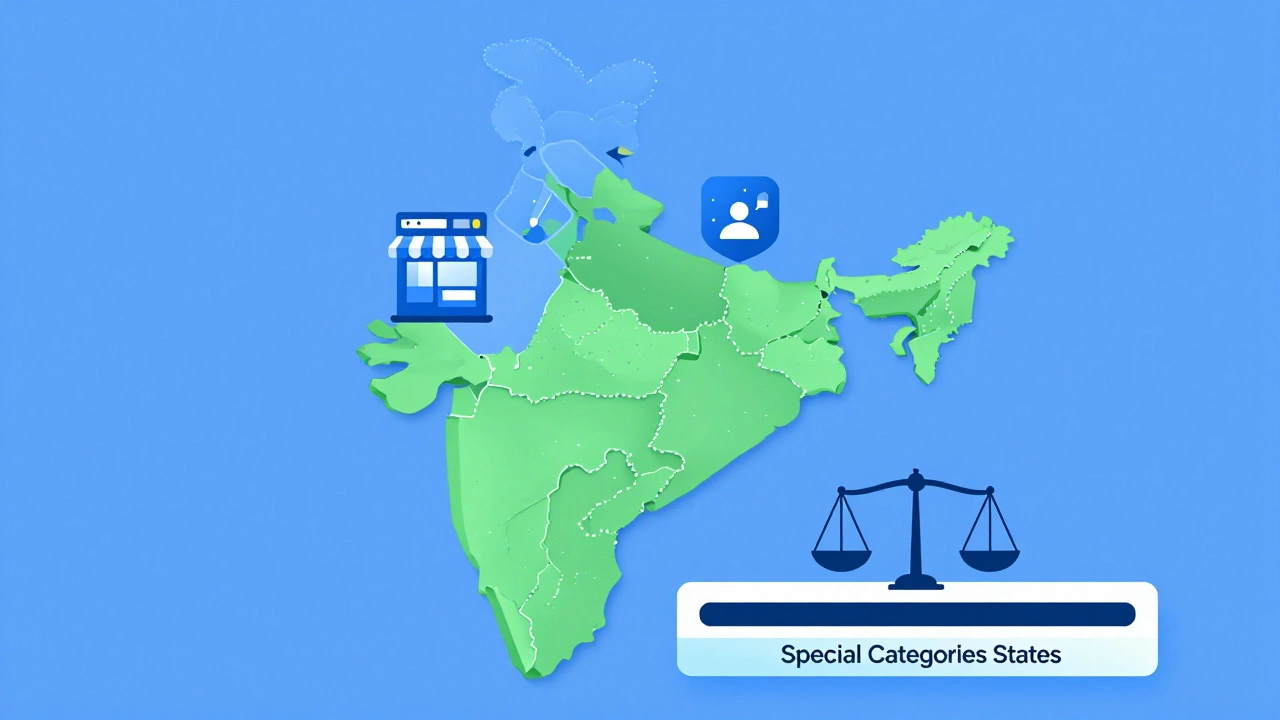
Special Category States: Lower Limits, Same Rules
India’s federal structure means some states have different economic conditions. To support smaller businesses in less developed regions, the government set lower turnover thresholds for “special category states.” These include:
- Arunachal Pradesh
- Assam
- Bihar
- Jammu & Kashmir
- Himachal Pradesh
- Meghalaya
- Mizoram
- Nagaland
- Odisha
- Puducherry
- Sikkim
- Tripura
- Manipur
- Meghalaya
- Uttarakhand
If your business is registered in any of these states, remember the ₹20 lakh (goods) and ₹10 lakh (services) limits. Crossing these triggers immediate registration obligations. Don’t assume the national average applies to you-check your state code.
Voluntary Registration: When Should You Opt-In?
You aren’t forced to register if you’re below the threshold, but many businesses choose to do so voluntarily. Why? Because GST registration unlocks the ability to claim Input Tax Credit is the mechanism allowing businesses to offset GST paid on purchases against GST collected on sales.
Here’s a practical example: Suppose you run a small consulting firm with ₹15 lakh in annual revenue. You’re exempt from mandatory registration. However, you buy laptops, software, and office furniture worth ₹5 lakh, paying ₹90,000 in GST. Without registration, that ₹90,000 is a sunk cost. If you register voluntarily, you can claim that credit back, effectively reducing your operational costs.
Other reasons to register voluntarily include:
- Credibility: Large B2B clients often prefer or require GST-registered vendors for their own compliance.
- Interstate Trade: If you plan to expand beyond your home state, having a GSTIN makes logistics smoother.
- Export Benefits: Registered exporters can claim refunds on GST paid during production.

Who Is Exempt from GST Entirely?
Not all economic activity attracts GST. Certain sectors and entities are completely outside the GST net. Understanding these exemptions can save you time and money.
1. Agricultural Produce: Fresh fruits, vegetables, grains, and other unprocessed agricultural products are generally exempt. However, once you process them (e.g., turning wheat into packaged flour), GST may apply.
2. Alcohol for Human Consumption: Interestingly, alcohol is excluded from GST and remains taxed by individual states under excise duties. This is a political compromise rather than an economic logic.
3. Petroleum Products: Crude oil, petrol, diesel, and natural gas are currently outside the GST framework. They are subject to state VAT and central excise separately.
4. Small Service Providers Below Threshold: As mentioned, if you provide services and stay under ₹20 lakh (or ₹10 lakh in special states), you don’t pay GST unless you opt in.
5. Specific Financial Services: Banking services, insurance premiums, and stock market transactions are largely exempt or zero-rated to avoid cascading taxes in the financial sector.
Consequences of Non-Compliance
Ignoring GST obligations when you should be registered isn’t a victimless crime. The consequences can be severe:
- Penalties: You may face a penalty of 100% of the tax evaded, up to a maximum of ₹10,000.
- Interest Charges: Late payment attracts interest at 18% per annum on the unpaid tax amount.
- Prosecution: In cases of willful evasion, criminal prosecution is possible, including imprisonment.
- Blocked Input Credits: Your suppliers may be unable to claim input tax credit on sales to you, damaging your business relationships.
The GST Network (GSTN) uses data analytics to track mismatches between purchase and sale invoices. If your supplier reports a sale to you, but you haven’t registered or filed returns, the system flags it. Don’t gamble with compliance.
How to Check Your GST Liability
Determining whether you need to pay GST involves a simple checklist:
- Calculate Aggregate Turnover: Add up all taxable supplies across all states for the last 12 months.
- Identify Business Type: Are you selling goods, services, or both? Do you operate in a special category state?
- Check for Mandatory Triggers: Do you sell interstate, use e-commerce platforms, or act as an agent?
- Review Exemptions: Does your product/service fall under exempt categories like agriculture or petroleum?
If you’re still unsure, consult a Chartered Accountant (CA). The cost of professional advice is minimal compared to potential penalties. Remember, GST compliance is ongoing-you must file monthly or quarterly returns, maintain proper records, and update your details if your business structure changes.
In summary, GST affects a wide range of businesses in India. While small traders below the threshold can breathe easy, anyone engaged in interstate trade, e-commerce, or high-value services must navigate the registration process carefully. Stay informed, keep accurate records, and treat GST not as a burden, but as a tool for transparent and efficient business growth.
What is the current GST turnover limit for registration in 2026?
For most states, the limit is ₹40 lakh for goods suppliers and ₹20 lakh for service providers. In special category states, these limits are halved to ₹20 lakh and ₹10 lakh respectively.
Do I need GST registration if I sell only within my state?
If your turnover is below the threshold and you don't fall under mandatory categories like e-commerce operators, you may not need registration. However, registering voluntarily allows you to claim input tax credits.
Is alcohol included in GST?
No, alcoholic liquor for human consumption is explicitly excluded from GST and continues to be taxed by state governments under their own excise laws.
Can I register for GST if my turnover is below the limit?
Yes, voluntary registration is allowed. This is beneficial if you want to claim input tax credits on purchases or deal with large B2B clients who require GST-compliant vendors.
What happens if I fail to register when required?
You may face penalties equal to the tax evaded (up to ₹10,000), interest charges at 18% per annum, and potential legal prosecution. Your business credibility may also suffer.
