
Startup India Eligibility Checker (2026)
Eligibility Assessment Result
Recommended Next Steps
Many founders believe that any small business can call itself a "startup" and access government benefits. The reality is stricter. To unlock tax exemptions, easier compliance, and funding access under the Startup India initiative, your company must meet specific legal and financial thresholds defined by the Department for Promotion of Industry and Internal Trade (DPIIT). If you are planning to launch a venture in India or have recently incorporated, knowing exactly who qualifies is critical. Missing one criterion means losing out on significant financial incentives. This guide breaks down the exact eligibility rules, the types of entities that can apply, and the common pitfalls that cause applications to be rejected.
Key Takeaways
- Age Limit: Your entity must be less than 10 years old from its date of incorporation.
- Turnover Cap: Annual turnover must not exceed ₹500 Crores (approx. $60 Million USD) at any point during the last three financial years.
- Entity Type: Only Private Limited Companies, LLPs, and Registered Partnerships are eligible; sole proprietorships are excluded.
- Innovation Requirement: You must demonstrate that your business is scalable and innovative through a self-declaration.
The Three Core Eligibility Criteria
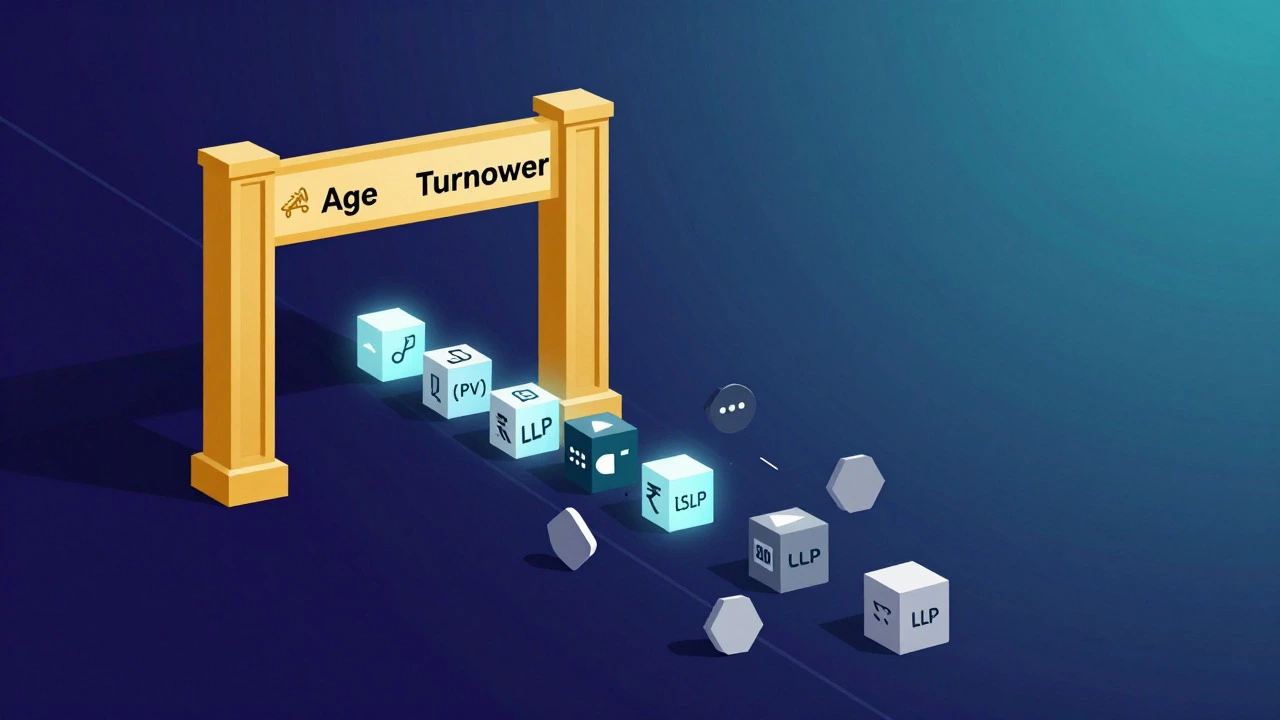
The DPIIT uses three strict filters to determine if an entity qualifies as a startup. If you fail even one, you are not eligible for recognition. Let's look at each in detail.
1. Age of the Company
Your business must be young. Specifically, it must have been incorporated or registered within the last 10 years. For example, if today is August 21, 2026, your company was incorporated on or after August 21, 2016. Once you cross this 10-year mark, you lose eligibility automatically. There is no extension process. This rule ensures the scheme supports new ventures rather than established mature businesses seeking retroactive benefits.
2. Turnover Limits
This is where many growing companies get tripped up. Your annual turnover should not exceed ₹500 Crores in any financial year preceding the application year. Let’s clarify what "turnover" means here. It refers to gross revenue, not profit. If your net profit is low but your sales volume is high, you still count toward this limit. The check covers the last three financial years. So, if you applied in 2026, the DPIIT will look at your revenues for FY 2023-24, FY 2024-25, and FY 2025-26. If any single year crossed ₹500 Crores, you are ineligible.
3. Innovation and Scalability
This is a qualitative criterion. You must prove that your business is innovative and has the potential to scale. Unlike the age and turnover checks, which are binary (pass/fail), this relies on a self-declaration. However, "innovative" doesn't just mean using new technology. It can include:
- A novel product or service.
- A new business model that disrupts existing markets.
- Significant improvement in efficiency or quality over existing solutions.
Which Business Structures Qualify?
Not every legal structure in India can apply for Startup India recognition. This is a frequent source of confusion for solo founders.
| Entity Type | Eligible? | Key Condition |
|---|---|---|
| Private Limited Company | Yes | Must not be a subsidiary of another company unless that parent is also recognized as a startup. |
| Limited Liability Partnership (LLP) | Yes | Must be registered with the Registrar of Companies. |
| Registered Partnership Firm | Yes | Must be registered under the Indian Partnership Act, 1932. |
| Sole Proprietorship | No | Excluded entirely due to lack of separate legal identity. |
| Public Limited Company | No | Generally excluded unless meeting very specific niche criteria (rare). |
If you are currently operating as a Sole Proprietorship, you cannot apply directly. You must first convert your business into a Private Limited Company or an LLP. This conversion takes time and involves legal costs, so plan ahead if you want to secure startup status early in your journey.
Common Reasons for Rejection
Even if you think you meet the criteria, applications often fail due to administrative errors. Here are the top three reasons:
- Incorrect CIN/UIN Number: Ensure the Corporate Identity Number (CIN) for companies or Unique Identification Number (UIN) for LLPs matches exactly what is on your MCA (Ministry of Corporate Affairs) records. A single digit error leads to automatic rejection.
- Misunderstanding "Innovation": Founders often describe their business too generically. Instead of saying "we sell online," say "we use AI-driven logistics to reduce delivery times by 40% in Tier-2 cities." Specificity helps the evaluator understand the innovation factor.
- Missing Documents: While the process is digital, you may need to upload proof of incorporation and recent financial statements. Incomplete uploads cause delays.
What Do You Get After Approval?
Eligibility is only useful if the benefits matter to you. Once recognized, your startup gets:
- Tax Exemption: Income tax holiday for up to 3 consecutive years out of the first 10 years (subject to conditions).
- Easier Compliance: Reduced burden of regulatory compliance, including relaxed norms for public procurement.
- Funding Access: Easier access to debt financing and equity investment through the Fund of Funds managed by SIDBI.
- Idea Protection: One-year extended protection period for patents.

Step-by-Step: How to Check Your Eligibility
Before filling out the official form, run this quick self-check:
- Check Date: Calculate the difference between today’s date and your incorporation date. Is it less than 10 years?
- Check Revenue: Pull your P&L statements for the last 3 fiscal years. Did any year exceed ₹500 Crores?
- Check Structure: Are you a Pvt Ltd, LLP, or Registered Partnership?
- Describe Innovation: Can you write a clear 2-3 sentence statement about why your business is unique and scalable?
Frequently Asked Questions
Can a foreign investor-owned company apply for Startup India?
Yes, provided the company is incorporated in India. There is no restriction on the nationality of shareholders. However, the company must comply with FEMA (Foreign Exchange Management Act) regulations regarding foreign direct investment limits in specific sectors.
What happens if my turnover exceeds ₹500 Crores after I am recognized?
Your recognition remains valid until the end of the 10-year window. You do not lose status immediately upon crossing the turnover limit in a subsequent year, but you cannot reapply if you ever drop below the limit and then rise again later. The eligibility check is primarily for the initial application phase.
Is there a fee for applying to Startup India?
No, the application process via the DPIIT portal is completely free. You only pay professional fees if you hire a consultant to prepare your documents, which is optional.
Can I apply for Startup India status while raising seed funding?
Yes, and it is highly recommended. Many investors prefer investing in DPIIT-recognized startups because of the associated tax benefits and credibility. Having the certificate ready can speed up due diligence.
Does 'innovation' require a patent?
No. A patent is helpful but not mandatory. You can claim innovation based on a new business model, a unique distribution channel, or a significant improvement in user experience. The self-declaration allows you to define what makes your venture distinct.
