
LLC Tax Estimator (2026)
Your Inputs
Includes Self-Employment Tax & QBI Deduction
Split between Salary & Distribution
Flat 21% + Qualified Dividends
* Calculations are estimates based on 2026 projected tax brackets. Consult a CPA for actual filing requirements. Standard deduction assumed at $15,100. No other deductions included.
There is no single "LLC tax rate." If you are looking for a specific percentage to plug into a calculator right now, you will come up empty-handed. That’s because the Internal Revenue Service (IRS) does not tax Limited Liability Companies (LLCs) as a distinct entity by default. Instead, the IRS looks past the LLC structure to see who owns it and how it chooses to be taxed.
This confusion trips up thousands of business owners every year. You might hear that small businesses pay 21%, or you might hear they pay up to 37%. Both numbers are real, but neither applies to your LLC automatically. Your actual tax bill depends entirely on your classification: Sole Proprietorship, Partnership, S Corporation, or C Corporation.
Understanding this distinction is the difference between overpaying thousands of dollars in taxes and keeping more profit in your pocket. Let’s break down exactly how the money flows and what rates apply to each scenario in 2026.
The Default Rule: Pass-Through Taxation
By default, the IRS treats an LLC as a pass-through entity. This means the LLC itself pays zero federal income tax. Instead, the profits "pass through" the business directly to the owner(s), who then report those earnings on their personal tax returns.
If you have a single-member LLC, you are treated as a sole proprietor. If you have multiple members, you are treated as a partnership. In both cases, you do not file a separate corporate tax return for income purposes. You use Schedule C (for single-member) or Schedule K-1 (for multi-member) attached to your personal Form 1040.
Because the income is reported on your personal return, it is subject to individual income tax brackets. For the 2026 tax year, these brackets range from 10% to 37%. The exact rate you pay depends on your total taxable income, which includes your LLC profits plus any other income you have, such as a W-2 salary or investment gains.
- 10% bracket: Income up to $11,925
- 12% bracket: Income from $11,926 to $48,475
- 22% bracket: Income from $48,476 to $103,350
- 24% bracket: Income from $103,351 to $197,300
- 32% bracket: Income from $197,301 to $389,300
- 35% bracket: Income from $389,301 to $609,350
- 37% bracket: Income over $609,350
Notice that these are marginal rates. You don’t pay 37% on every dollar you earn; you only pay that rate on the portion of income that exceeds the threshold. Most small business owners fall into the 12%, 22%, or 24% brackets.
The Hidden Cost: Self-Employment Tax
Here is where many new LLC owners get shocked. When you receive a paycheck from an employer, they withhold Social Security and Medicare taxes. As an LLC owner with pass-through status, there is no employer withholding. You are responsible for paying these yourself.
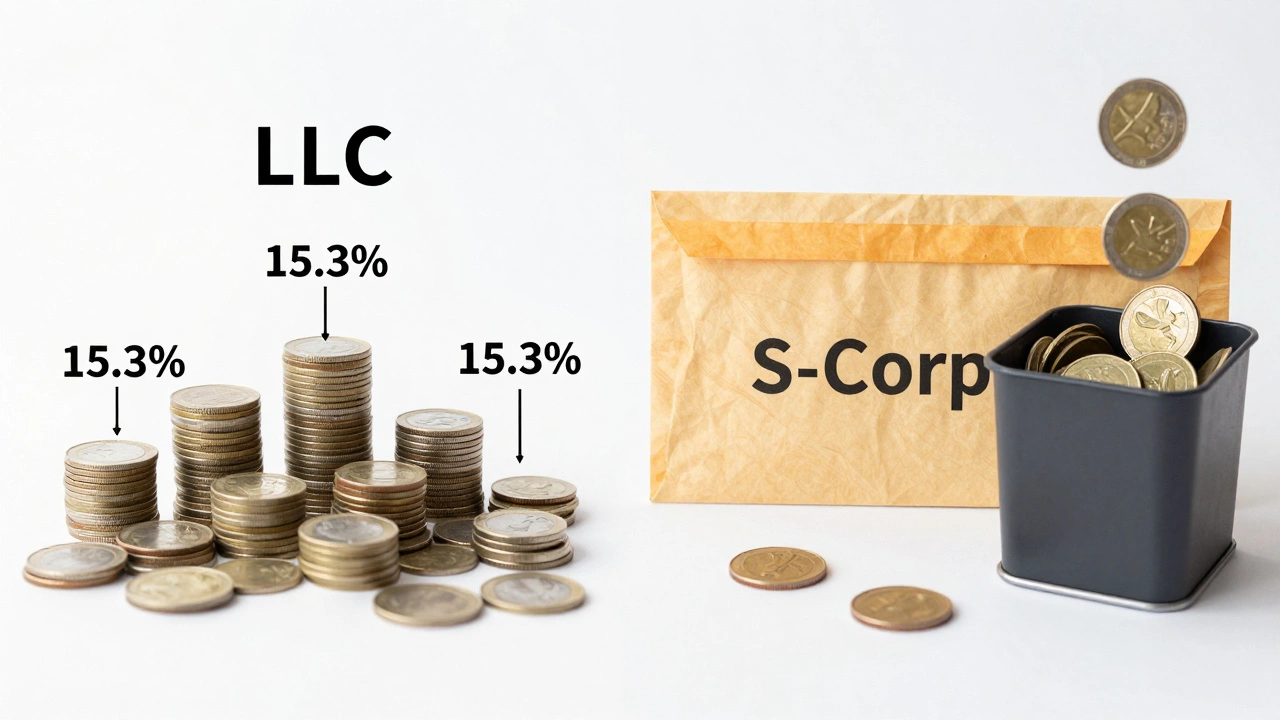
This is called the Self-Employment Tax, and it adds a flat 15.3% to your tax burden. It consists of two parts:
- Social Security Tax: 12.4% on net earnings up to the wage base limit ($176,100 in 2026).
- Medicare Tax: 2.9% on all net earnings, with no cap.
If your annual LLC income is high enough, you may also owe the Additional Medicare Tax of 0.9% on earnings above $200,000 (for single filers). So, if you make $100,000 in profit, you aren't just paying income tax on that amount. You are effectively paying an extra 15.3% in payroll taxes. However, you can deduct half of this self-employment tax when calculating your adjusted gross income, which slightly lowers your final bill.
Electing S Corp Status: The Game Changer
Many successful LLC owners eventually choose to elect S Corporation status. You do this by filing IRS Form 2553. This changes how you are taxed without changing your legal business structure.
As an S Corp, you split your compensation into two buckets: reasonable salary and distributions. You must pay yourself a reasonable salary for the work you do, and that salary is subject to the full 15.3% employment tax (FICA). However, any remaining profits taken as distributions are not subject to self-employment tax. They are only subject to individual income tax.
This strategy saves money because you avoid the 15.3% payroll tax on the distribution portion of your income. For example, if your LLC makes $200,000, you might pay yourself a $80,000 salary and take $120,000 as distributions. You only pay payroll taxes on the $80,000. This can save tens of thousands of dollars annually, but it comes with stricter record-keeping requirements and potential audit scrutiny if the IRS deems your salary "unreasonable."

Electing C Corp Status: Double Taxation Risk
Some LLCs choose to be taxed as a C Corporation by filing IRS Form 8832. This is less common for small businesses but popular for startups seeking venture capital or planning to go public.
A C Corp is a separate taxable entity. It pays a flat 21% federal corporate tax rate on its profits. This rate was established by the Tax Cuts and Jobs Act and remains in effect for 2026.
The catch is double taxation. The corporation pays 21% on profits. Then, when you distribute those after-tax profits to shareholders (you) as dividends, you pay personal income tax on those dividends again. Qualified dividends are taxed at preferential rates of 0%, 15%, or 20%, depending on your income level. While the 21% corporate rate sounds low compared to top individual brackets, the combined effective tax rate often ends up higher than pass-through structures unless you reinvest most profits back into the business rather than taking them out.
| Classification | Entity Tax Rate | Owner Tax Rate | Payroll Taxes | Best For |
|---|---|---|---|---|
| Default (Sole Prop) | 0% | 10%-37% (Individual) | 15.3% on all profit | Low-revenue startups, side hustles |
| Partnership | 0% | 10%-37% (Individual) | 15.3% on all profit | Multi-owner service businesses |
| S Corporation | 0% | 10%-37% (on distributions) | 15.3% only on salary | Profits >$60k-$80k/year |
| C Corporation | 21% Flat | 0%-20% (Dividends) | Employer/Employee split | Venture-backed startups, retained earnings |
Qualified Business Income Deduction (QBI)
There is one major benefit for pass-through entities that corporations do not get: the Qualified Business Income Deduction. Under Section 199A of the tax code, eligible taxpayers can deduct up to 20% of their qualified business income from their taxable income.
This deduction applies before you calculate your final tax liability. If you earn $100,000 in LLC profit, you might only be taxed on $80,000 of that income. This effectively lowers your tax rate significantly. For example, if you are in the 22% bracket, the QBI deduction could drop your effective rate to roughly 17.6% on that income.
However, this deduction phases out for high-income earners in certain "specified service trades or businesses" (SSTBs), such as health, law, accounting, actuarial science, performing arts, consulting, athletics, financial services, brokerage services, or any trade or business where the principal asset is the reputation or skill of its employees or owners. If your income exceeds the threshold ($191,950 for single filers in 2026), you may lose access to this deduction entirely.
State Taxes: The Other Half of the Equation
Federal taxes are only part of the story. Depending on where your LLC is registered and operates, you may face state income taxes, franchise taxes, or local business fees. California, for instance, charges an $800 minimum annual franchise tax regardless of profit. New York has complex city and state surtaxes. Texas has no individual income tax but imposes a franchise tax on businesses. Always check your specific state’s Department of Revenue guidelines, as these rules change frequently.
How to Determine Your Best Strategy
Choosing the right tax classification isn't just about picking the lowest number. It involves balancing cash flow, administrative complexity, and future goals. Here is a simple decision framework:
- Estimate Net Profit: If your LLC expects to make less than $60,000-$80,000 in net profit, stick with the default pass-through status. The cost of setting up an S Corp (payroll processing, separate bank accounts, accounting fees) usually outweighs the tax savings.
- Assess Reinvestment Needs: If you plan to keep most profits in the business to fund growth, a C Corp might offer advantages due to the lower 21% rate on retained earnings.
- Consider Long-Term Exit: If you plan to sell the company or bring in investors, an S Corp or C Corp structure is often preferred for liability protection and valuation clarity.
- Consult a Pro: Tax laws are complex. A CPA can run projections based on your specific income, deductions, and state residency to tell you exactly which election saves you the most money.
The bottom line is that there is no universal LLC tax rate. Your rate is a custom calculation based on your income level, your chosen entity classification, and your eligibility for deductions like QBI. By understanding these mechanics, you move from guessing to strategizing, ensuring you keep the maximum amount of hard-earned revenue.
Does an LLC pay taxes on its own?
By default, no. Most LLCs are pass-through entities, meaning the business itself pays no federal income tax. Profits are reported on the owner's personal tax return. However, if the LLC elects to be taxed as a C Corporation, it pays a flat 21% corporate tax rate.
What is the average tax rate for an LLC owner?
There is no fixed average, but most small business owners fall into the 12% to 24% individual income tax brackets. When adding the 15.3% self-employment tax, the effective tax rate often lands between 20% and 30% of net profit, depending on deductions and credits.
Can I avoid self-employment tax as an LLC owner?
Yes, by electing S Corporation status. As an S Corp, you pay yourself a reasonable salary subject to payroll taxes, but the remaining profits distributed to you are not subject to self-employment tax. This requires formal election with the IRS and adherence to payroll regulations.
Is the 21% corporate tax rate better for an LLC?
Not necessarily. The 21% rate applies only if you elect C Corp status. While 21% is lower than top individual brackets, you face double taxation when distributing profits as dividends. For most small businesses taking profits home, pass-through taxation with the QBI deduction is more beneficial.
Do I need to file quarterly taxes for my LLC?
If you expect to owe $1,000 or more in taxes for the year, you must make estimated quarterly tax payments to the IRS. This covers both income tax and self-employment tax. Failure to do so can result in penalties and interest.
