
Business Plan Break-Even Calculator
Enter Your Financial Data
Your Results
Total Break-Even Target (First Month):
0 Units
Enter your numbers and click calculate to see your break-even point.
Most entrepreneurs think they need a hundred-page document to launch a business. They don’t. In fact, investors and banks often prefer concise, clear plans over dense novels. If you are asking yourself how to draw a simple business plan, you are already on the right track. A simple business plan is a streamlined roadmap that outlines your business goals, target market, and financial strategy without unnecessary fluff. It forces you to clarify your value proposition and proves you have done your homework.
You do not need to be a writer or an accountant to create this. You just need to answer five core questions honestly. This guide will walk you through building a lean, effective plan using free tools and proven frameworks. Whether you are looking for a one-page business plan format or a slightly more detailed outline, the principles remain the same.
Why Start with a One-Page Business Plan?
Before diving into spreadsheets, start small. The concept of a one-page business plan gained massive popularity thanks to entrepreneur Tim Berry, who argued that if you can’t explain your business in one page, you don’t understand it well enough. This approach removes the paralysis many founders feel when staring at a blank Word document.
A short plan serves three critical purposes:
- Clarity: It forces you to prioritize what matters most.
- Speed: You can draft it in an afternoon instead of weeks.
- Flexibility: It is easier to update as your market changes.
Think of this first draft as a sketch. You can always add color later. For now, focus on the structure. Using a business plan template can help you avoid missing key sections, but do not let the template dictate your content. Your unique insights matter more than pre-filled boxes.
Step 1: Define Your Executive Summary
The executive summary is the hook. Even though it appears at the beginning of your document, write it last. It should summarize the entire plan in 150-200 words. Investors often read only this section before deciding whether to look further.
Include these four elements:
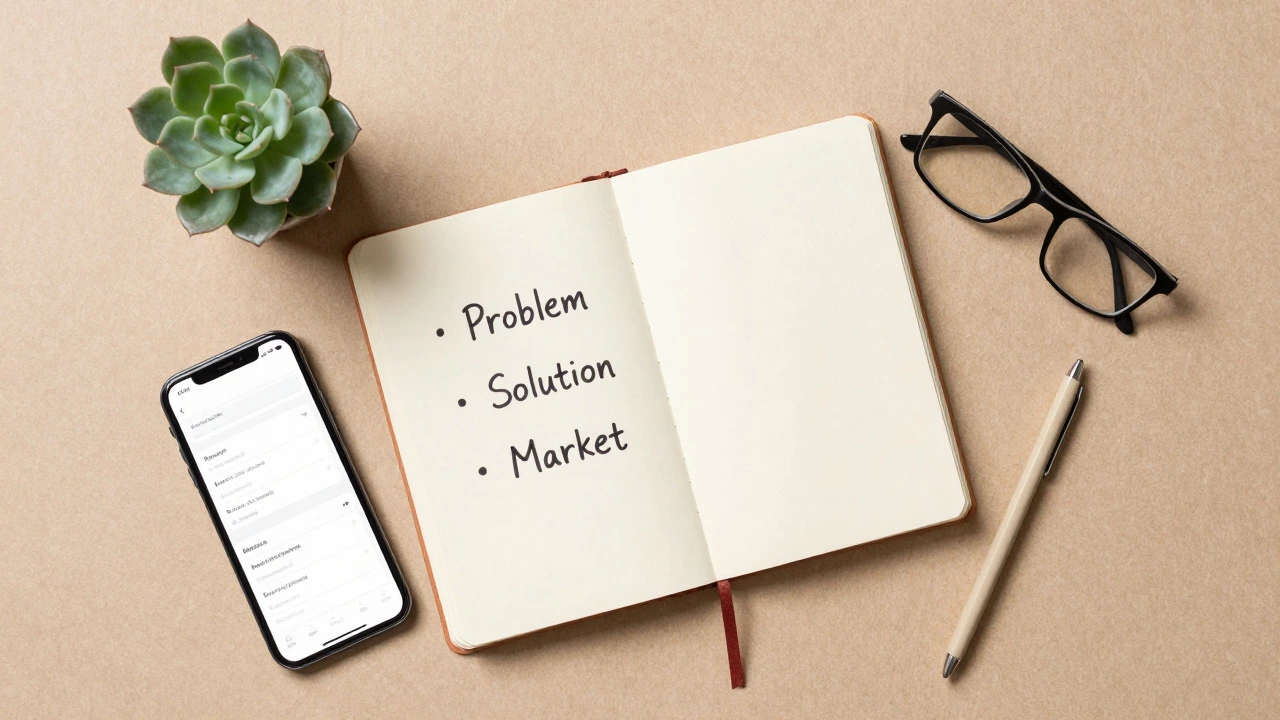
- The Problem: What pain point are you solving?
- The Solution: How does your product or service fix it?
- The Market: Who are your customers?
- The Ask: Are you seeking funding, partners, or just validation?
For example, if you are starting a mobile pet grooming service, your summary might say: "Local pet owners struggle to find reliable groomers during work hours. Our mobile van brings professional grooming to their driveways between 8 AM and 4 PM. We target busy professionals in Sydney’s eastern suburbs and seek $15,000 in seed funding for vehicle acquisition." See how specific that is? Vague statements like "we want to provide great service" tell the reader nothing.
Step 2: Describe Your Products and Services
This section explains exactly what you sell. Avoid jargon. Write as if you are explaining your business to a friend who knows nothing about your industry. Focus on benefits, not just features.
Ask yourself:
- What makes my offering different from competitors?
- Is there a patent, proprietary technology, or unique process involved?
- What is the lifecycle of the product?
If you are selling software, mention the tech stack briefly (e.g., built on React and Node.js) but emphasize user experience. If you are opening a café, highlight your sourcing strategy (e.g., locally roasted beans) rather than just listing menu items. Specificity builds credibility.
Step 3: Analyze Your Market and Competition
You cannot succeed in a vacuum. You need to prove you know who your customers are and who else is trying to serve them. This requires basic market research. You do not need expensive reports; use free resources like government census data, industry association websites, and competitor analysis.
Define your target audience clearly. Instead of saying "everyone aged 18-65," narrow it down. For instance: "Freelance graphic designers in Australia aged 25-40 who spend over 40 hours a week on computers and suffer from back pain." This specificity helps you tailor your marketing messages.
Next, identify your direct and indirect competitors. List three main rivals. Note their strengths and weaknesses. Then, state your competitive advantage. Why will customers choose you? Is it price, convenience, quality, or customer service? Be honest. If your competitor is cheaper, acknowledge it and explain why your premium option is worth the extra cost.
Step 4: Outline Your Marketing and Sales Strategy
Having a great product means nothing if no one knows about it. This section details how you will attract and retain customers. Break it down into two parts: marketing (awareness) and sales (conversion).
For marketing, list your channels. Will you use social media ads, search engine optimization (SEO), email newsletters, or local partnerships? Be specific about platforms. Saying "social media" is too broad. Saying "Instagram Reels targeting fitness enthusiasts in Melbourne" is actionable.
For sales, describe your funnel. How does a stranger become a paying customer? Do you offer free trials? Consultations? Discounts for early adopters? Include your pricing strategy here. Explain how you determined your prices-cost-plus, value-based, or competitive benchmarking.
| Strategy | Best For | Risk |
|---|---|---|
| Cost-Plus | Manufacturing, Retail | Ignoring customer willingness to pay |
| Value-Based | Consulting, SaaS | Misjudging perceived value |
| Competitive | Commodities, E-commerce | Price wars eroding margins |
Step 5: Project Your Financials
This is where many beginners get stuck. You do not need to be a CFO, but you must show you understand basic economics. Include three key documents:
- Startup Costs: A one-time list of expenses to launch (equipment, licenses, initial inventory).
- Monthly Operating Expenses: Recurring costs like rent, salaries, software subscriptions, and utilities.
- Revenue Forecast: Realistic estimates of sales for the first 12 months.
Use conservative numbers. Assume sales will be 20% lower than your best-case scenario. Calculate your break-even point-the month when total revenue equals total costs. Tools like Excel or Google Sheets are sufficient for this. There are many free financial projection templates available online that automate the formulas.
Example: If your monthly fixed costs are $5,000 and your average profit per unit sold is $50, you need to sell 100 units per month to break even. Can you realistically achieve that? If not, adjust your costs or pricing.

Tools and Templates to Speed Up the Process
You do not have to start from scratch. Several platforms offer guided experiences for creating business plans. While paid tools exist, free options are often enough for a simple plan.
- LivePlan: Offers robust templates but requires a subscription for full access.
- Bplans.com: Provides thousands of real-world examples you can study for inspiration.
- Canva: Great for visual one-page plans and pitch decks.
- Google Docs: Search for "Lean Canvas template" to find community-created, free versions.
The Lean Canvas, created by Ash Maurya, is a popular alternative to traditional business plans. It fits on one page and focuses heavily on problems, solutions, key metrics, and unfair advantages. It is particularly useful for tech startups and agile businesses.
Common Mistakes to Avoid
Even with a simple plan, pitfalls exist. Here are the most frequent errors I see:
- Overestimating Revenue: Founders often project exponential growth from day one. Base your forecasts on verifiable data, not hope.
- Ignoring Competition: Saying "we have no competitors" is a red flag. It usually means you haven’t looked hard enough.
- Vague Marketing Plans: "We will use social media" is not a strategy. Specify platforms, budgets, and KPIs.
- Skipping the Exit Strategy: Investors want to know how they will get their money back. Mention potential acquisition targets or IPO timelines if applicable.
Review your plan critically. Ask a mentor or peer to read it. Fresh eyes catch logical gaps you might miss.
Next Steps After Drafting
Once your simple business plan is complete, treat it as a living document. Review it quarterly. Update your financial projections as actual data comes in. Adjust your marketing tactics based on performance metrics.
If you are seeking funding, tailor the plan to your audience. Banks care about collateral and cash flow stability. Venture capitalists care about scalability and market size. Highlight the sections that matter most to them.
Remember, the goal of a business plan is not to impress with length but to align your team and secure resources. Keep it simple, keep it accurate, and keep it updated.
How long should a simple business plan be?
A simple business plan should be between 10 and 15 pages, excluding appendices. For a one-page version, aim for 300-500 words. The key is clarity, not volume. Most readers will skim, so use headings and bullet points to make it scannable.
Do I need a business plan if I am bootstrapping?
Yes. Even without external investors, a plan helps you manage cash flow and set milestones. It acts as a checklist to ensure you have considered all critical aspects of launching and operating your business.
What is the difference between a business plan and a pitch deck?
A business plan is a detailed written document used for internal planning and deep-dive reviews by lenders. A pitch deck is a visual presentation (usually 10-15 slides) used to spark interest during meetings with investors. The plan supports the deck.
How often should I update my business plan?
Update it at least annually. However, revise it immediately after significant events, such as launching a new product, entering a new market, or experiencing a major shift in financial performance.
Can I use a template for my business plan?
Absolutely. Templates save time and ensure you cover all necessary sections. Just customize the content thoroughly. Generic text raises red flags for investors. Use the template as a skeleton, not the final body.
