
Small Business Million-Dollar Potential Calculator
Enter your current business metrics to see how close you are to hitting ₹1 Crore (approx $120k) in annual revenue and whether your unit economics support sustainable growth.
Enter your data to calculate Lifetime Value (LTV), Required Customers, and Unit Economics health.
Most people think you need venture capital to build a million-dollar business. They picture sleek offices in Bangalore or Gurgaon, teams of fifty, and burn rates that would make your accountant cry. But here is the truth: some of the most profitable companies in India started as tiny operations with almost no external funding. Think about it. Did Zomato start with millions? No. It started with two guys and a website. Can a small business actually hit that seven-figure mark in revenue? Absolutely. But it requires a shift in how you view growth, margins, and customer loyalty.
The Myth of Instant Scale
We often confuse "revenue" with "profit." A small business can generate ₹1 crore (roughly $120,000) in sales easily if it sells low-margin goods in high volume. But making millions in net profit? That’s a different beast entirely. In the Indian context, where price sensitivity is high and competition is fierce, the path to millions isn’t about selling more units; it’s about capturing higher value per unit. You don't need a billion users. You need a thousand customers who love you enough to buy from you repeatedly.
Consider the local D2C (Direct-to-Consumer) brands popping up on Instagram. Many are hitting ₹50 lakhs to ₹1 crore in annual revenue within their first three years. How? They didn't try to compete with Amazon on logistics. They competed on brand story and niche targeting. If you are running a small operation, stop trying to be everything to everyone. Pick a specific pain point and solve it better than anyone else. That focus is what allows you to charge a premium, which is the fastest route to higher margins.
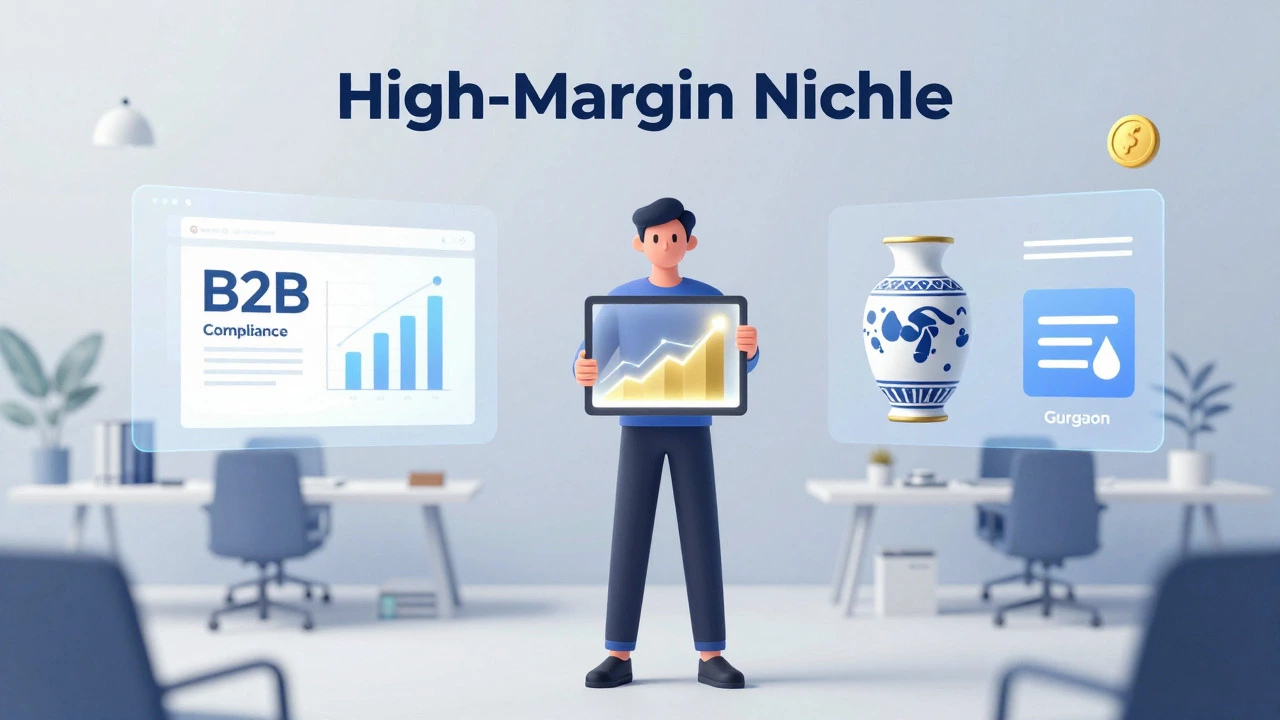
High-Margin Niches in India
Not all industries are created equal when it comes to scalability. Selling generic t-shirts might get you volume, but the margins will eat you alive once you factor in returns and shipping. To reach millions efficiently, you need sectors with inherent leverage. Here are three categories where small Indian businesses are quietly building wealth:
- Specialized B2B Services: Instead of general marketing, offer compliance automation for startups. Once you build the software or process, selling to client number 100 costs almost nothing compared to client number one.
- Premium Handicrafts & Export: India has world-class artisans. A small exporter focusing on sustainable home decor can command high prices in Europe and the US. The margin here isn't in manufacturing; it's in curation and branding.
- Niche SaaS Solutions: Building a tool for regional language accounting or specific GST filing needs. These tools have low overhead and high retention rates because switching costs are high for the user.
The key attribute here is scalability without linear headcount growth. If every new rupee of revenue requires hiring another employee, your path to millions is slow and painful. Look for models where technology or systems do the heavy lifting.
| Business Model | Average Margin | Scalability Factor | Time to ₹1 Crore Revenue |
|---|---|---|---|
| Retail Trading | 5-10% | Low (Inventory heavy) | 3-5 Years |
| Service Agency | 20-30% | Medium (Talent dependent) | 2-4 Years |
| D2C Brand | 40-60% | High (Marketing driven) | 1-3 Years |
| SaaS/Product | 70-80% | Very High (Code driven) | 2-5 Years |
Leveraging Digital Infrastructure
Ten years ago, starting a business meant renting space, buying inventory, and hoping for foot traffic. Today, the infrastructure cost has collapsed. Thanks to platforms like Shopify, Razorpay, and Shiprocket, a solo entrepreneur in Jaipur can sell to a customer in New York without owning a warehouse. This democratization of tools is the biggest accelerator for small businesses aiming for big numbers.
But having the tools isn't enough. You need to master the Customer Acquisition Cost (CAC) versus Lifetime Value (LTV) equation. Many small businesses die because they spend too much acquiring customers who only buy once. If you spend ₹500 to get a customer who spends ₹2,000 once, you’re losing money after COGS and overheads. But if that same customer buys four times a year, your LTV jumps to ₹8,000. Now you have room to scale advertising.
Focus on retention over acquisition. It costs five times more to acquire a new customer than to keep an existing one. For a small business, this means investing in email marketing, WhatsApp updates, and exceptional support. When you treat your first 100 customers like royalty, they become your unpaid sales team. Word-of-mouth in tight-knit communities-whether it's corporate HR managers or mom groups-can drive massive organic growth at zero cost.
The Power of Bootstrapping
Investors want 10x returns. They push you to grow fast, even if it means burning cash. As a small business owner, you don't have to play that game. Bootstrapping-funding your growth from profits-gives you control. You decide when to hire, when to expand, and when to take a break. This discipline often leads to healthier financials. You learn to operate lean. Every rupee spent must justify itself.
Look at companies like Zerodha. They became giants without raising external capital for years. Why? Because they focused on product excellence and low operational costs. You can apply the same logic. Keep your fixed costs low. Use freelancers instead of full-time staff until absolutely necessary. Rent co-working spaces instead of long-term leases. By keeping your break-even point low, you can survive market downturns that crush debt-heavy competitors. And surviving is half the battle in reaching millions.
Realistic Timelines and Pitfalls
Let’s manage expectations. Reaching ₹1 crore in revenue is a milestone many small businesses hit. Reaching ₹1 crore in profit is rare. Reaching $1 million (approx ₹8.3 crores) in revenue is achievable for top-tier small businesses, but it usually takes 5-7 years of consistent execution. Don't fall for the "overnight success" stories on LinkedIn. Behind those headlines are years of failed experiments, pivot moments, and late nights.
The biggest pitfall? Premature scaling. This happens when you increase spending on ads and staff before you’ve proven your unit economics work. You get busy, but not profitable. Before you hire your tenth employee, ask yourself: Does each additional customer bring in more margin than the cost to serve them? If the answer is no, fix the model before you pour fuel on the fire.
Another trap is ignoring tax and compliance. In India, GST filings, TDS, and income tax audits can drain resources if not managed well. Automate these processes early. Use accounting software like Tally or Zoho Books from day one. Clean books attract investors later if you choose that route, but more importantly, they give you clarity on where your money is going.
Final Thoughts: It’s About Leverage
Can a small business make millions? Yes. But it won’t happen by working harder alone. It happens by leveraging systems, technology, and brand equity. You need to move from being an operator to being a strategist. Stop trading hours for dollars. Build assets-whether that’s a digital product, a strong brand, or a loyal customer base-that continue to pay you while you sleep.
The barrier to entry is lower than ever, but the barrier to sustained growth is higher than ever because everyone has access to the same tools. Differentiation is key. Find your niche, obsess over your customers, keep your costs lean, and let compounding do the rest. The millions aren't just for the funded startups. They are for the disciplined small business owners who understand the math behind the magic.
Is it realistic for a service-based business to reach 1 crore in revenue?
Yes, but it requires moving away from hourly billing. Service businesses often hit a ceiling because revenue is tied directly to time. To reach 1 crore, you need to productize your services (create packages), raise your prices significantly, or build a team so you are not the bottleneck. Agencies that specialize in high-value niches like legal tech or healthcare compliance often achieve this faster than generalist agencies.
Do I need external funding to scale my small business to millions?
No. While funding accelerates growth, it also dilutes ownership and adds pressure. Many profitable Indian businesses bootstrap successfully. Funding is useful if you need to capture market share quickly against deep-pocketed competitors. If you are in a niche market with less competition, reinvesting profits is often a safer and more controlled way to scale.
What is the biggest mistake small businesses make when trying to grow?
Premature scaling. This means increasing expenses (marketing, hiring, office space) before establishing a repeatable sales process and positive unit economics. Owners often mistake activity for progress. If you don't know exactly how much it costs to acquire a customer and how much that customer spends over their lifetime, scaling will likely lead to losses, not profits.
How important is branding for a small business aiming for high revenue?
Crucial. Without a brand, you are a commodity competing solely on price. Price wars destroy margins. A strong brand allows you to charge a premium because customers trust you and identify with your values. For example, two similar coffee shops exist; one charges ₹150 for a latte because of its ambiance and story, while the other charges ₹80. The branded one scales better because customers return for the experience, not just the caffeine.
Which sectors in India currently offer the best potential for small business growth?
Currently, health-tech, ed-tech (specifically vocational training), sustainable consumer goods, and B2B SaaS for SMEs show strong potential. These sectors benefit from digital adoption trends in India. Additionally, export-oriented handicrafts and food products are seeing growth due to global demand for authentic Indian products. The common thread is solving a specific problem with scalable delivery mechanisms.
