
Ask ten people which Indian state has the best governance, and you’ll likely get ten different answers. Some will point to the glittering skylines of Mumbai or Bengaluru. Others might mention the disciplined streets of Kerala or the industrial parks of Gujarat. But feelings don’t pay bills, and anecdotes don’t build infrastructure. If you’re a business owner looking to expand, an investor scouting opportunities, or a citizen concerned about public services, you need hard data, not hearsay.
In 2026, "good governance" isn't just a political slogan; it’s a measurable set of outcomes. It involves how efficiently a state delivers healthcare, education, water supply, and law enforcement. It also covers the ease of doing business, digital transparency, and fiscal health. The central agency responsible for tracking this is NITI Aayog, India's premier policy think tank that replaced the Planning Commission in 2015 to foster cooperative federalism. NITI Aayog publishes the Composite on State Performance Index (CPI), which ranks states across key sectors.
The Metrics That Define Good Governance
Before naming winners, we need to agree on what "winning" looks like. Governance is multidimensional. You can have great roads but terrible schools. You can have low crime rates but high corruption. To evaluate this objectively, experts look at five core pillars:
- Health & Nutrition: Access to primary care, maternal mortality rates, and malnutrition levels.
- Education: Literacy rates, school attendance, and quality of higher education institutions.
- Agriculture & Rural Development: Farmer income, irrigation coverage, and rural employment generation.
- Financial Inclusion & Infrastructure: Banking penetration, internet connectivity, and road/rail networks.
- Safety & Justice: Crime reporting efficiency, police-to-population ratio, and court pendency resolution.
These metrics are tracked through various government schemes and digital platforms. For instance, the success of Ayushman Bharat, India's national health protection mission providing health cover up to ₹5 lakh per family per year for secondary and tertiary care hospitalization varies significantly by state implementation. Similarly, the rollout of direct benefit transfers (DBT) via the Aadhaar system, India's biometric identification system used to authenticate residents for receiving subsidies and benefits depends heavily on state-level IT infrastructure and administrative willingness.
The Top Performers: Who Leads the Pack?
Based on recent NITI Aayog reports and independent economic surveys from 2025-2026, a clear hierarchy emerges. However, it’s important to distinguish between large states and small union territories, as their challenges differ vastly.
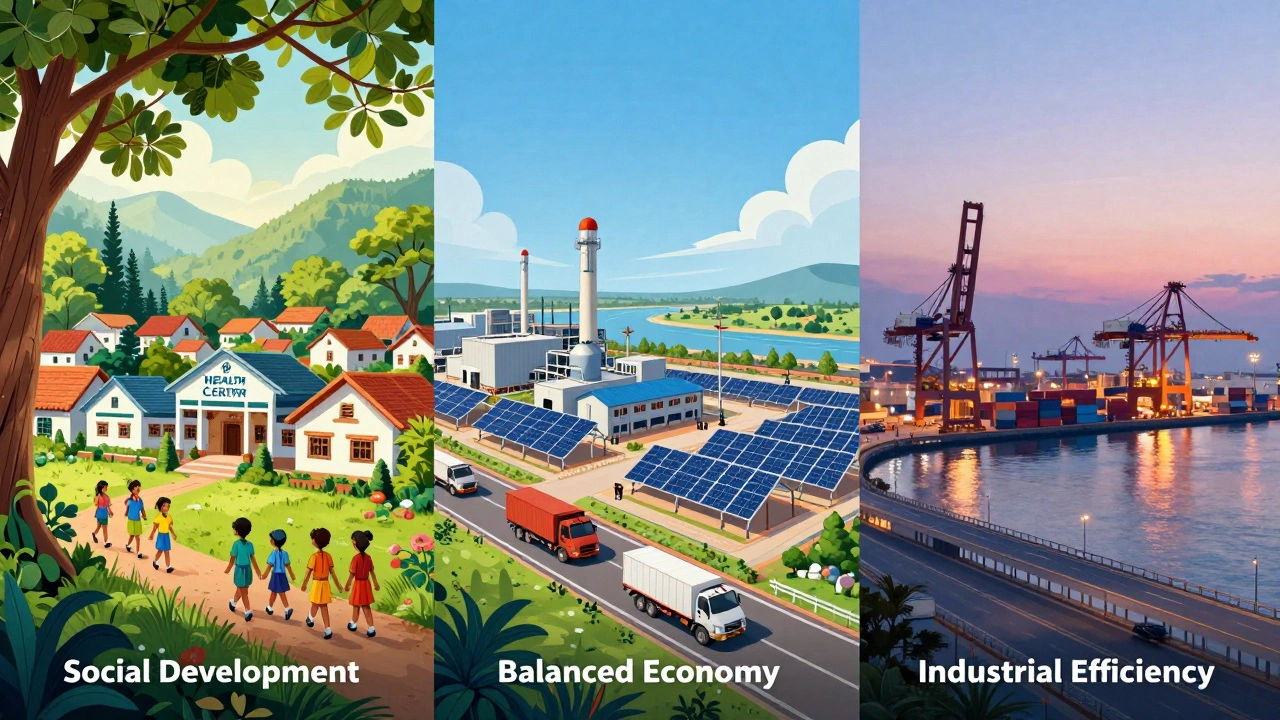
Kerala: The Social Development Champion
If your definition of good governance revolves around human capital, Kerala is consistently at the top. This southern state punches far above its weight in social indicators. It boasts near-universal literacy, one of the lowest infant mortality rates in the country, and exceptional life expectancy figures.
Why does Kerala succeed here? Decades of consistent investment in public health and education, even during periods of fiscal stress, have created a resilient population. The state’s decentralized planning model, initiated in the 1990s, allows local panchayats (village councils) significant control over budgets. This means resources often reach the grassroots level more effectively than in centralized systems. For citizens, this translates to reliable access to clean water, electricity, and primary healthcare centers in almost every village.
Tamil Nadu: The Balanced Powerhouse
While Kerala leads in social metrics, Tamil Nadu offers a more balanced profile that appeals to businesses and urban planners alike. It ranks highly in both social development and economic management. The state has maintained steady GDP growth, robust manufacturing sectors, and strong export performance.
Tamil Nadu’s governance strength lies in its institutional continuity. Unlike many states where policies flip-flop with every election cycle, Tamil Nadu has maintained long-term commitments to industries like automotive and textiles. Its single-window clearance system for business approvals is among the fastest in India. Furthermore, the state’s pension scheme and mid-day meal program are widely regarded as models of efficient welfare delivery, ensuring that economic growth doesn’t leave the vulnerable behind.
Gujarat: The Industrial Efficiency Leader
When people talk about "ease of doing business," Gujarat often comes up first. And for good reason. The state has invested heavily in physical infrastructure-ports, highways, and power grids. Its governance style is characterized by a strong executive focus on industrial facilitation.
Gujarat excels in financial inclusion and infrastructure. The state’s logistics costs are lower than the national average due to better road connectivity and port efficiency. For a manufacturer, this means faster time-to-market. However, critics often point out that while Gujarat scores well on economic metrics, its social sector indicators-particularly in rural health and sanitation-lag behind Kerala and Tamil Nadu. So, if you’re evaluating governance purely for commercial expansion, Gujarat is a top contender. If you’re looking for holistic social welfare, it’s a mixed bag.
The Small States & UTs: High Scores, Limited Scale
It’s impossible to discuss governance rankings without mentioning the smaller states and Union Territories (UTs). Goa, Himachal Pradesh, and Puducherry frequently top the charts in composite indices. Why? Because managing a smaller population with fewer geographical complexities is inherently easier.
Goa, for example, has high per-capita income and excellent tourism infrastructure. Himachal Pradesh leads in renewable energy adoption and environmental sustainability. However, these states face different challenges. Their economies are often niche-dependent (tourism, agriculture), making them vulnerable to external shocks. While their governance is "good" in terms of service delivery, their scalability and impact on the national economy are limited compared to giants like Maharashtra or Uttar Pradesh.
| State | Primary Strength | Weakness Area | Best For |
|---|---|---|---|
| Kerala | Health & Education | Industrial Growth | Skilled Labor, Healthcare Services |
| Tamil Nadu | Balanced Economy & Welfare | Water Scarcity | Manufacturing, IT, Auto Sector |
| Gujarat | Infrastructure & Logistics | Rural Social Metrics | Heavy Industry, Ports, Energy |
| Maharashtra | Financial Services & Diversity | Urban Congestion | Finance, Entertainment, Tech Hubs |
| Himachal Pradesh | Sustainability & Tourism | Scale of Impact | Eco-Tourism, Green Energy |
The Digital Governance Revolution
One cannot talk about modern governance in India without addressing the digital shift. The concept of Digital India, A campaign launched by the Government of India to transform India into a digitally empowered society and knowledge economy has changed how citizens interact with the state. But implementation is uneven.
States like Karnataka and Telangana have pioneered e-governance portals that allow citizens to apply for licenses, pay taxes, and file complaints online with minimal friction. Telangana’s "MeeSeva" centers, for instance, provide hundreds of government services under one roof, reducing the need for bribes and middlemen. This transparency is a hallmark of good governance.
In contrast, some larger northern states still struggle with digitizing land records and property rights. Without clear, digital title deeds, businesses hesitate to invest, and disputes linger in courts for decades. Therefore, when evaluating "good governance," check the state’s digital maturity. Can you do everything online? If yes, that’s a strong signal of efficient administration.
Fiscal Health: The Backbone of Sustainability
A state can spend lavishly on schemes today, but if it’s drowning in debt, that governance isn’t sustainable. Fiscal discipline is a critical, yet often overlooked, metric. States like Punjab and Bihar have historically struggled with high fiscal deficits and revenue shortfalls. This limits their ability to maintain infrastructure or hire qualified teachers and doctors.
Conversely, states like Madhya Pradesh and Rajasthan have shown improved fiscal health in recent years by broadening their tax base and improving collection efficiency. When a state balances its books, it can plan long-term projects rather than relying on central bailouts. For investors, a fiscally healthy state is less risky because it’s less likely to suddenly raise taxes or cut essential services to plug budget holes.
How to Use This Data for Your Decisions
So, which state actually has the "best" governance? The answer depends entirely on your goal.
- For Investors: Look at Tamil Nadu and Gujarat for manufacturing. Look at Maharashtra and Karnataka for tech and finance. Prioritize states with stable power supply and easy labor laws.
- For Job Seekers: Consider the industry. If you’re in healthcare, Kerala and Tamil Nadu offer world-class facilities. If you’re in IT, Bangalore (Karnataka) and Hyderabad (Telangana) remain hubs, despite traffic woes.
- For Citizens: If you value education and health, Kerala is unmatched. If you want a mix of opportunity and social safety nets, Tamil Nadu is a strong choice.
Don’t just rely on headlines. Dive into the latest NITI Aayog CPI report. Check the specific sub-index relevant to your needs. A state might rank 1st overall but drop to 15th in agricultural support. That nuance matters.

Common Pitfalls in Evaluating Governance
Many people make the mistake of equating "good governance" with "low crime." While safety is crucial, a police state with no economic freedom isn’t good governance. Similarly, don’t confuse "high spending" with "good outcomes." A state might spend billions on a new airport, but if its rural schools lack toilets, the governance is skewed.
Another pitfall is ignoring local context. What works in coastal Andhra Pradesh might fail in landlocked Jharkhand. Good governance is adaptive. It requires leaders who listen to local feedback and adjust policies accordingly. States with active civil society groups and free press tend to perform better because they have mechanisms for accountability.
Future Trends: What to Watch in 2027 and Beyond
As India moves further into 2026, climate resilience is becoming a key governance metric. States that proactively manage water scarcity, heatwaves, and flood risks will attract more investment and retain talent. Kerala and Tamil Nadu are already investing in climate-adaptive infrastructure. Meanwhile, states facing severe groundwater depletion, like parts of Punjab and Haryana, face a governance crisis that money alone won’t solve.
Additionally, the integration of artificial intelligence in public services is on the rise. Expect states to compete on who can deploy AI-driven customer service for grievances and predictive analytics for disaster management more effectively. The race for good governance is no longer just about building roads; it’s about building smart, responsive systems.
Which state is ranked #1 in governance in India?
There is no single "#1" because rankings depend on the criteria. Kerala typically ranks highest in social development (health and education). Tamil Nadu often leads in balanced performance across economy and welfare. Gujarat usually tops industrial and infrastructure metrics. NITI Aayog’s Composite on State Performance Index provides detailed yearly rankings based on multiple sectors.
What does NITI Aayog measure for state performance?
NITI Aayog measures performance across key sectors including health, nutrition, education, agriculture, financial inclusion, infrastructure, and safety. They use a combination of outcome-based indicators (like literacy rates) and process-based indicators (like fund utilization) to create a comprehensive scorecard for each state.
Is Gujarat better than Tamil Nadu for business?
It depends on your industry. Gujarat is generally preferred for heavy manufacturing, chemicals, ports, and energy due to superior logistics and infrastructure. Tamil Nadu is a leader in automotive, electronics, and textiles, with a strong ecosystem of suppliers and skilled labor. Both are top choices, but their strengths lie in different sectors.
How does digital governance affect state rankings?
Digital governance is increasingly weighted in assessments because it reduces corruption and improves service speed. States with robust e-governance platforms (like Telangana’s MeeSeva or Karnataka’s e-procurement) score higher on transparency and citizen satisfaction. Efficient digital systems also lower the cost of compliance for businesses.
Which states have the best healthcare systems?
Kerala consistently has the best public healthcare outcomes, with the lowest maternal and infant mortality rates. Tamil Nadu and Karnataka also perform very well, particularly in urban areas. These states have invested heavily in primary health centers and have high doctor-to-patient ratios compared to the national average.
