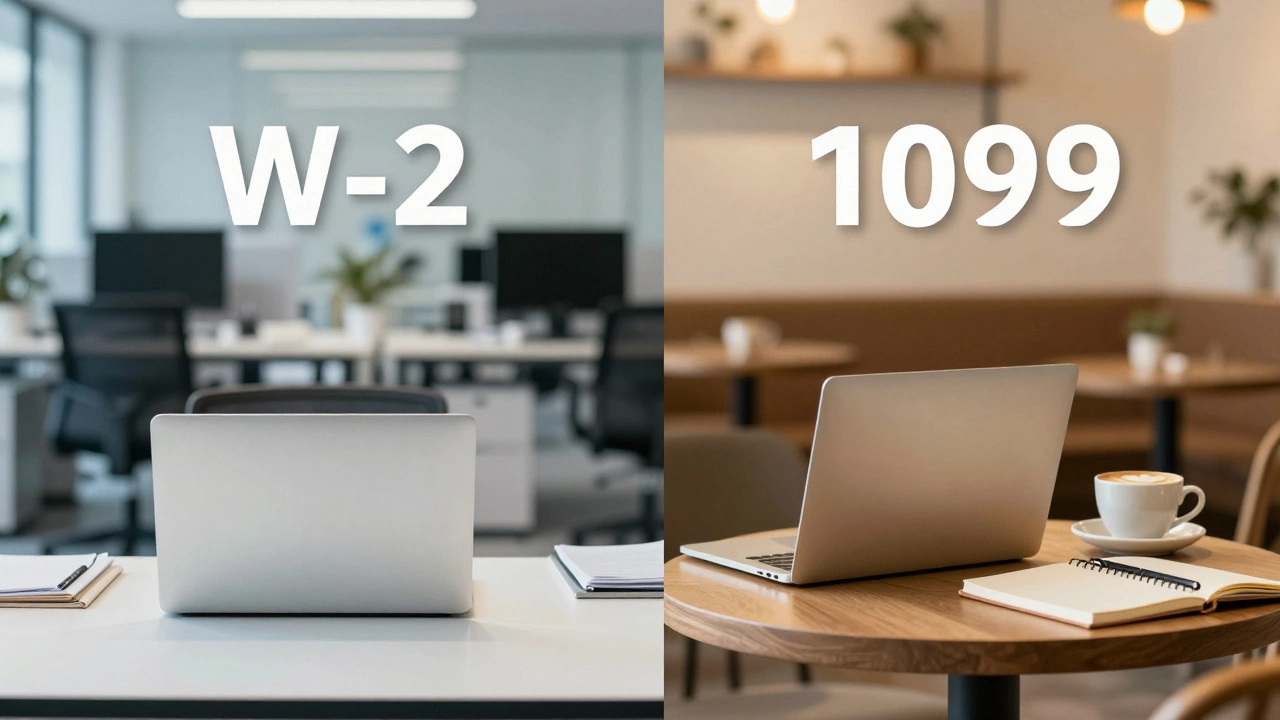
W-2 vs 1099 Income Comparison Calculator
W-2 Employee Offer
1099 Contractor Offer
$0
StableSalary + Benefits (Pre-income tax)
$0
FlexibleGross - Expenses - SE Tax (Pre-income tax)
Quick Breakdown
| Gross Earnings: | - |
| Self-Employment Tax (15.3%): | - |
| Business Deductions: | - |
Quick Summary: The Bottom Line
- W-2s offer stability, employer-paid taxes, and a safety net of benefits.
- 1099s provide higher hourly rates, tax write-offs, and total control over your time.
- The Trade-off: You trade security for freedom and simplicity for potential tax savings.
Understanding the Basics of the Two Paths
Before weighing the pros and cons, let's get the definitions straight. In the U.S., W-2 is the tax form an employer uses to report your annual wages and the taxes they've already withheld from your paycheck. If you have a W-2, you are an employee. The company controls when you work, where you work, and how you do the job.
On the flip side, 1099 refers to the form used for independent contractors or freelancers who are self-employed. As a 1099 worker, you aren't an employee; you're a business owner providing a service to a client. You generally decide your own hours and use your own equipment.
The core difference boils down to control. If your boss tells you to be at a desk by 9:00 AM every day and provides the laptop, you're almost certainly a W-2 employee. If you use your own MacBook, work from a coffee shop, and just hit a deadline by Friday, you're operating as a 1099 contractor.
The Money Talk: Taxes and Take-Home Pay
This is where most people get tripped up. When you're a W-2 employee, your employer pays half of your Social Security and Medicare taxes. They handle the math and send the money to the Internal Revenue Service (IRS) for you. You see a "net pay" on your stub that is relatively predictable.
When you move to 1099, that safety net vanishes. You are now responsible for the Self-Employment Tax. This means you pay both the employer and the employee portions of Social Security and Medicare. For 2026, this is roughly 15.3%. If you're making $60,000 as a contractor, you need to set aside a significant chunk of every check, or you'll face a massive tax bill in April.
However, 1099s have a superpower: business deductions. A W-2 employee can't usually deduct their internet bill or a new office chair from their taxes. A contractor can. If you spend $5,000 a year on software, travel, and equipment, you only pay taxes on your profit (Revenue minus Expenses), not your gross income. This can significantly lower your taxable income if you have high overhead.
| Feature | W-2 Employee | 1099 Contractor |
|---|---|---|
| Tax Withholding | Employer handles it | You handle it (Quarterly) |
| FICA Taxes | Split with employer | You pay 100% (Self-Employment Tax) |
| Expenses | Reimbursed by company | Deductible as business costs |
| Benefits | Health, 401k, Paid Time Off | You buy and fund your own |
| Work Control | Employer dictates terms | You dictate the process |
The Hidden Cost of Benefits
When comparing a W-2 salary to a 1099 rate, you cannot just look at the hourly number. You have to calculate the "Total Compensation." A W-2 job often comes with Health Insurance, which the company might subsidize by thousands of dollars per year. Then there's the 401(k) match-free money that compounds over decades.
Consider a scenario: You're offered $50/hour as a W-2 employee with health insurance and 3 weeks of paid vacation. Then you're offered $75/hour as a 1099 contractor. At first glance, the 1099 offer looks 50% better. But once you pay for your own health plan ($400+/month), pay the full self-employment tax, and account for the fact that you don't get paid when you take a vacation, that $25 gap shrinks rapidly. Usually, a 1099 rate needs to be 25% to 40% higher than a W-2 salary to provide the same standard of living.
Don't forget about disability and life insurance. If a W-2 employee gets injured, they might have short-term disability coverage. A 1099 contractor has zero income the moment they stop working, unless they've spent their own money to buy a private policy.
Freedom, Flexibility, and the Risk Factor
For some, the financial math is secondary to the lifestyle. The 1099 route allows you to work for multiple clients simultaneously. This is a huge risk-mitigation strategy. If a W-2 employee is fired, their income drops to zero instantly. If a contractor with five clients loses one, they only lose 20% of their income. This is called "income diversification."
The flexibility is also real. Want to take a Tuesday afternoon off to go to the gym or pick up your kids? If you're 1099 and your deliverables are met, no one cares. If you're W-2, you're requesting PTO or sneaking out of the office. For high-performers who can work faster than the average person, 1099 is often more lucrative because they can juggle multiple contracts and maximize their billable hours.
The downside? You are the HR department, the accountant, and the sales team. You spend time chasing unpaid invoices and managing contracts instead of doing the actual work you're paid for. The administrative burden of being 1099 is a "hidden tax" on your time.
Avoiding the Misclassification Trap
Here is a warning: some companies try to hire people as 1099 contractors when they are actually employees. They do this to avoid paying taxes and benefits. This is called Employee Misclassification. If a company treats you like an employee (controls your hours, provides your tools, prevents you from working for others) but pays you as a contractor, they are breaking the law.
Why does this matter to you? Because if the IRS decides you were actually an employee, the company might be forced to pay back taxes, but you might also find yourself in a complicated situation regarding your own filings. More importantly, you're missing out on the benefits and legal protections (like overtime pay under the Fair Labor Standards Act) that you are entitled to as a W-2 worker.
If you're unsure, ask yourself: "Do I have the right to decide how this work gets done?" If the answer is no, you're likely an employee and should be on a W-2.
Making Your Final Decision
So, which one is actually better? It depends on your stage of life and your risk tolerance. If you're early in your career, have a spouse with great health insurance, and want to maximize your earnings by working 60 hours a week across three different projects, W-2 vs 1099 is a no-brainer: go 1099. The tax write-offs and autonomy will fuel your growth.
If you have a family, need a predictable monthly budget, and value the peace of mind that comes with a guaranteed salary and paid sick leave, the W-2 path is far superior. The "hidden" value of a corporate benefits package is often higher than the extra cash a contractor receives.
One pro tip for those choosing 1099: set up a separate business bank account immediately. Never mix your personal spending with your business income. It makes your tax season a breeze and ensures you don't accidentally spend the money that belongs to the government.
Do I have to pay quarterly taxes as a 1099 contractor?
Yes, generally. Because no one is withholding taxes from your check, the IRS requires you to make estimated tax payments four times a year. If you wait until April to pay everything, you may face underpayment penalties. A good rule of thumb is to save 25-30% of every check in a high-yield savings account specifically for taxes.
Can a W-2 employee also have 1099 income?
Absolutely. This is often called "side hustling." You can have a full-time W-2 job and take on freelance 1099 projects on the side. In this case, your employer handles the taxes for your salary, but you are still responsible for the self-employment taxes on your freelance earnings.
What are the most common 1099 tax deductions?
Common deductions include a portion of your home internet, phone bills, home office square footage, software subscriptions (like Adobe or Microsoft 365), professional certifications, and business travel. Always keep your receipts and track your mileage if you travel for work.
Which status is better for getting a mortgage?
W-2 income is generally preferred by lenders because it is stable and easy to verify. 1099 workers can get mortgages, but lenders usually require two years of consistent tax returns to prove that your business income is stable. They look at your net profit, not your gross revenue, which means those great tax deductions can actually make your income look lower to a bank.
Can I switch from 1099 to W-2?
Yes, this happens often. Many companies start someone as a contractor to "test the waters" and then offer a full-time position. This requires a new employment agreement and a change in how you are paid and taxed. Ensure you get the new terms in writing, especially regarding benefits and seniority.
Next Steps and Troubleshooting
If you're currently 1099 and feeling overwhelmed: Start by using a dedicated bookkeeping tool. Don't rely on a spreadsheet. Automating your expense tracking will save you hours of stress during tax season.
If you're considering a switch: Calculate your "break-even" rate. Take your desired W-2 salary, add the cost of a private health plan, add 7.65% (the employer's share of FICA), and add 15% for the lack of paid time off. That is the minimum hourly rate you should ask for as a contractor.
If you suspect misclassification: Review your contract and your daily routine. If the company controls your specific work methods and hours, you may want to request a transition to W-2 status or consult with a tax professional to see if you should file for employee status with the government.
